
Plumbing labor cost per hour calculator
Plumbing labor cost per hour is what one billable hour costs your shop once wages, payroll burden and overhead are counted. Put your numbers in below and you’ll get your break-even rate and the billable rate that hits your target margin. Results show up as you type, with no email, and they stay in your browser.
What plumbing labor cost per hour includes
Plumbing labor cost per hour includes three layers: the wage, the payroll burden on that wage, and the overhead each billable hour has to carry. And the wage is the small part. The Bureau of Labor Statistics put median pay for plumbers, pipefitters and steamfitters at $30.67 an hour in May 2025. That figure is what a worker earns. What a shop should bill is a different number.
The gap gets so wide because paid hours and billable hours are two different things. You pay your tech for the drive, the supply house run and the callback, and none of those hours bill. Plumbing labor rates in the market are a separate question. For that one, see the plumber hourly rate guide.
How to use the labor rate calculator
The labor rate calculator takes eight inputs and returns six results. It opens loaded with the example shop, so you can watch it work before you put in your own numbers.
| Input | What to enter |
|---|---|
| Number of techs | Techs who bill work |
| Average tech wage | Dollars per hour |
| Payroll burden | Payroll taxes, workers’ comp and benefits, as a % of wages |
| Paid hours per tech, per year | 2,080 is 40 hours x 52 weeks |
| Billable share of paid hours | Hours sold divided by hours paid |
| Yearly overhead | Trucks, insurance, office, software, owner’s pay |
| Target net margin | The profit share you want |
| Your current hourly rate | Optional, for the yearly gap |
The results are billable labor rate, break-even rate, yearly labor cost, yearly billable hours, yearly revenue needed from labor, and the gap at your current rate. Copy link to these numbers saves the inputs in a web address.
How to calculate your plumber labor rate
A plumber labor rate comes from dividing total labor and overhead cost by billable hours, then adding your target margin. Here are the six steps, worked out for the example three-truck shop. The numbers are made up, so follow along with yours.
Step 1: Add up yearly wages
Start with what you pay out. Multiply techs by wage by paid hours. 3 x $32 x 2,080 = $199,680.
Step 2: Add payroll burden
Now put the burden on top. Multiply wages by 1 plus your burden. $199,680 x 1.12 = $223,642.
Step 3: Add yearly overhead
This is what it takes to keep the doors open: the trucks, the insurance, the office, software and your own pay. The example shop’s overhead is $210,000, and adding that in brings the total to $433,642.
Step 4: Find billable hours
Now count only the hours you actually sell. Multiply techs by paid hours by billable share. 3 x 2,080 x 0.60 = 3,744 hours.
Step 5: Find your break-even rate
Divide total cost by billable hours. $433,642 / 3,744 = $115.82 an hour. At that rate everybody gets paid, owner included, and the shop makes nothing more on labor.
Step 6: Add your target margin
Divide break-even by 1 minus your target margin. $115.82 / (1 – 0.15) = $136.26 an hour. There’s your number. The example shop uses $136 in its prices.
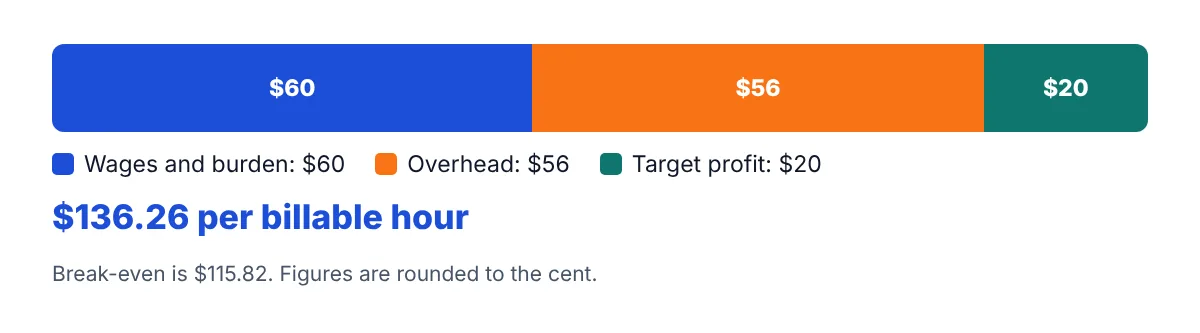
Say this shop bills $120 today. The calculator shows it’s short $60,887 a year. That comes from the gap between $120 and the unrounded $136.26 billable rate, across 3,744 billable hours. Once you have a rate, the flat rate price calculator turns it into job prices. Profit on parts is separate, so use the plumbing markup calculator for that. This calculator doesn’t set a minimum charge either. For that, go to the service call fee guide.
Break-even rate vs billable rate
The break-even rate is the hourly figure that covers all cost, and the billable rate is the break-even rate plus profit. You need both. Your billable rate goes into your prices. Your break-even rate is the floor, the number you don’t go under on a discount or a one-off deal. Anja Smith made the same point about rates in Plumber Magazine on 15 Jul 2019: flat prices built on a rate with no profit in it hold no profit.
What goes in payroll burden
Payroll burden is everything an employer pays on top of the wage, starting with FICA and FUTA. Employer FICA is 6.2% Social Security plus 1.45% Medicare, or 7.65%, with a 2026 Social Security wage base of $184,500. Federal unemployment tax, or FUTA, is 6.0% on the first $7,000 of wages, which falls to 0.6% with the full credit. That comes to $42 a tech.
Run it for a $32 tech at 2,080 hours. Wages are $66,560. FICA adds $5,092 and FUTA adds $42, so you’re at about 7.7% in total. Workers’ comp, state unemployment tax and benefits sit on top of that, and they vary by state and shop. The example shop’s 12% is a made-up figure, so pull your real number from your payroll reports.
What billable share to use
Billable share is hours sold divided by hours paid, and your own timesheets are the only reliable source for it. We found no independent measured figure for plumbing. What’s published is vendor opinion, and it doesn’t agree.
| Source | Published figure | Type and date |
|---|---|---|
| ServiceTitan blog | 40% to 50% of a workday, called a national average, no source given | Vendor, 11 Jul 2025 |
| ServiceTitan billable hours page | 30% is good for most service companies, 50% is extremely efficient | Vendor, undated |
| Aptora | Billed to paid hours target of 75% or more | Vendor, 8 Jan 2021 |
| Ruth King, HVACR Business | Example assumes 75% billed, HVAC | Trade press, Nov 2018 |
Don’t rush past this one, because it moves your rate more than most inputs. Here’s the example shop at three billable shares, with everything else left alone:
| Billable share | Billable hours | Break-even | Billable rate at 15% margin |
|---|---|---|---|
| 50% | 3,120 | $138.99 | $163.51 |
| 60% | 3,744 | $115.82 | $136.26 |
| 70% | 4,368 | $99.28 | $116.80 |
HVAC labor rate note
An HVAC labor rate uses the same math, so this calculator works as an HVAC hourly rate calculator if you enter HVAC wages, burden, overhead and billable share. The rest of this page is written for plumbing.
The FlatPriced app is planned to start from this same rate. Its setup wizard will ask for your labor rate first, as the plumbing flat rate software page describes. The app is in pre-launch, but this calculator works today.
FAQs
How do you calculate labor cost for a small business?
Add yearly wages, payroll burden and overhead, then divide by the hours you actually sell. For the example three-truck shop, $223,642 in labor plus $210,000 in overhead, over 3,744 billable hours, gives $115.82 an hour. That’s your break-even. Divide by 1 minus your target margin to get a billable rate. Those numbers are made up, just to show the math.
How much does plumber labor cost a shop per hour?
Plumber labor costs a shop far more per hour than the wage. Median pay is $30.67 an hour per the Bureau of Labor Statistics, May 2025, but in our made-up example the cost per billable hour is $115.82 once burden, unbilled time and overhead are counted. Market billing rates are in the plumber hourly rate guide.
What payroll burden percentage should I use?
Use your own payroll reports. Employer FICA alone is 7.65% of wages up to the 2026 Social Security wage base, and FUTA adds a small amount on the first $7,000 of each tech’s pay. Workers’ comp, state unemployment tax and benefits vary by state and shop. The 12% in our example is a made-up number.
Should the owner’s pay go in overhead?
Yes, if the owner doesn’t bill. The example shop includes the owner’s pay in its $210,000 overhead, so break-even already pays the owner. If you run a truck yourself, enter yourself as a tech at a fair wage, or put your pay in overhead. Pick one or the other, because counting your pay twice inflates your rate.
Does this plumbing labor calculator work for a one-truck shop?
Yes. Enter 1 tech, your wage, your burden and your overhead. A solo owner’s billable share is often the input to watch, because the quoting, the invoicing and the supply house runs all land on one person. Use a few weeks of your own records for that figure, since we found no independent benchmark to give you.
Sources
- Bureau of Labor Statistics, Occupational Outlook Handbook: Plumbers, Pipefitters, and Steamfitters, modified 29 Oct 2026
- IRS Topic 751, Social Security and Medicare withholding rates, 24 Sep 2026
- IRS Topic 759, Form 940, FUTA, 24 Sep 2026
- ServiceTitan, plumbing cost estimator guide, 11 Jul 2025
- ServiceTitan, billable hours, undated, seen 3 Nov 2026
- Aptora, profitability ratios, 8 Jan 2021
- HVACR Business, service profitability, Nov 2018
- Plumber Magazine, Is flat rate pricing the silver bullet, 15 Jul 2019