
How to create a price book for a plumbing shop in 2026
To create a price book, set your labor rate, list the jobs you sell most, set hours from your own job history, cost the parts, and run each job through one formula. Start with 20 to 40 jobs, test them on past invoices, then add more as you go.
Starting a new shop? How to start a plumbing business covers the license, costs and setup first.
Before you start: what you need on the desk
A plumbing shop needs four things before building a price book: last year’s invoices, payroll and overhead figures, a recent supply house statement, and dispatch or job records showing how long work took. A price book is only as good as those numbers.
Start small. One PlumbingZone thread from 2008, “Flat Rate Price Book – HELP!!!”, has about 54,000 views, so you’re not alone if the job looks big. On the other end, a ServiceTitan Community user reported deleting 23,000 unused Profit Rhino elements in May 2022. A short book you trust beats a huge one nobody opens.
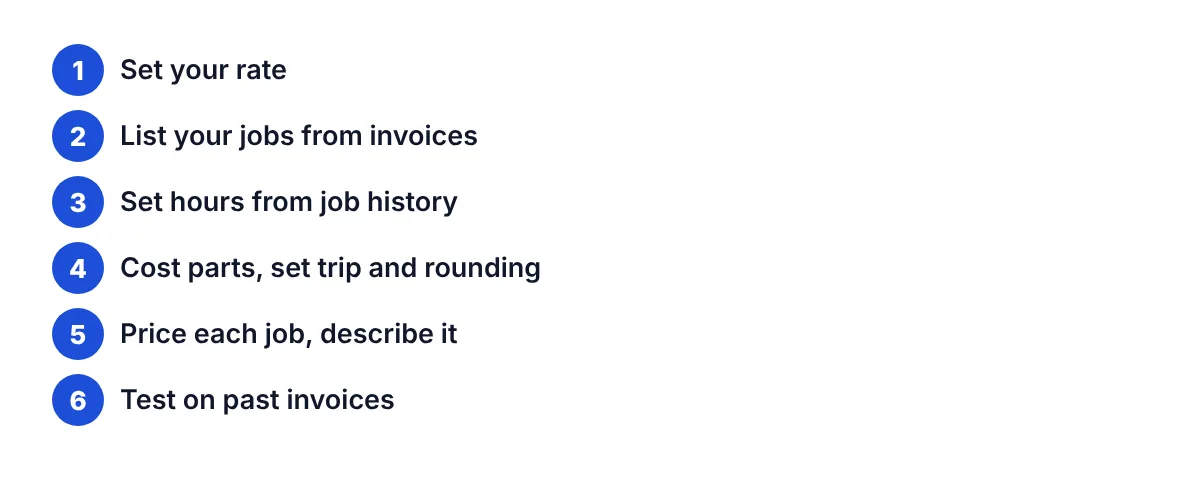
How to create a price book in eight steps
Work through these eight steps in order, because each one feeds the next.
Step 1: Set your labor rate
Your labor rate has to cover pay, burden, unbilled time, overhead and profit. The plumber labor rate calculator gives you a break-even rate and a billable rate. This guide uses the example shop’s $136 an hour and $115.82 break-even (example shop, made-up numbers).
Step 2: List the jobs you actually sell
Pull 12 months of invoices and count how often each job shows up. Write jobs the way a customer would describe them: “replace toilet fill valve”, not “service call, 1 hr”. Rank them, then take the top 20 to 40.
Step 3: Set hours from your own job history
Give each job the hours it takes one tech in your shop, from arrival to departure, in normal conditions. The next section covers timing. Use the typical job here, and don’t go by your best day. Leave room for the seized nut and the corroded shut-off you run into on older houses.
Step 4: Cost the parts
Build a parts list for each job at your current supply house price. Count what really goes on the truck for that job, including the flex connector, wax ring and tape. Apply a markup, and use the plumbing markup calculator to see the margin you keep.
Step 5: Set your trip charge and rounding
Decide your trip charge once, then build it into each price so the customer sees one number. To set it, use the service call fee guide. Round every price to the nearest $5 so prices read clean on the page.
Step 6: Run the formula on every job
Use (hours x labor rate) + (parts cost x (1 + markup)) + trip charge, then round. The worked example below shows it. After pricing each job, check the margin. If a job comes in thin, go look at your hours and parts before you touch the rate.
Step 7: Write what’s included
Write one or two lines per job, so every tech is quoting the same scope. State the part grade, what’s included and what’s not. For a toilet replacement, say whether a new wax ring, closet bolts and supply line are in the price and what happens if the flange is rotted.
Step 8: Test it on past invoices
Take 20 recent invoices and price them from the new book. Pull out the jobs where the book price is far from what you charged, then find out why. Sometimes the hours are wrong. Sometimes you’ve been undercharging.
Worked example: pricing a toilet fill valve
A toilet fill valve replacement comes to $185 in the example shop. The inputs are 0.75 hours, an $18 part at 100% markup and a $45 trip charge (example shop, made-up numbers).
- Labor: 0.75 x $136 = $102
- Parts: $18 x 2.00 = $36
- Trip charge: $45
- Raw total: $102 + $36 + $45 = $183
- Flat price, rounded to the nearest $5: $185
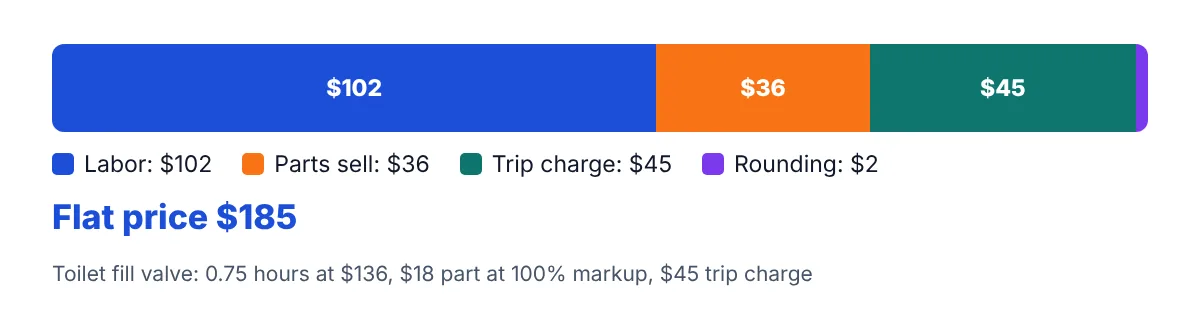
Now do the margin check. At the $115.82 break-even rate, the job costs 0.75 x $115.82 + $18 = $105. Take that off the $185 and you’ve got $80, or 43% of the price, left after labor, overhead and parts.
Notice that in this example the small job carries a higher margin than the big one. The $1,645 water heater in the same shop works out to 27%, because parts carry a lower markup.
How to time your plumbing jobs
Timing plumbing jobs means logging on-site start and finish times for each job type, then using the typical result. The guide to how long plumbing jobs take has a five-step routine and the published ranges.
FlatPriced’s planned starter hours have the same limit: no working plumber has checked them yet. Wherever your starting hours come from, swap them out for your own job history.
How many jobs should a price book have?
A price book for a small shop should start with the 20 to 40 jobs you sell most, then grow from there. Aptora’s blog says about 100 core tasks cover roughly 80% of the work, and advises leaving out any task you don’t sell five or six times a year. Treat that as a vendor’s rule of thumb, because we found no independent figure.
If a job is rare, just price it by the formula when it comes up. Sell it a few more times and it earns a line in the book.
An afternoon plan for your first 20 jobs
An afternoon is a reasonable goal for pricing your first 20 jobs if your invoices and payroll numbers are already on hand. This plan is only a suggestion, so don’t sweat it if your first run takes longer.
| Time | Task | Done when |
|---|---|---|
| First 30 minutes | Set your labor rate | You have a break-even and a billable rate |
| Next 45 minutes | Rank last year’s jobs | You have a top 20 list |
| Next 60 minutes | Set hours from records | Each job has one hours figure |
| Next 45 minutes | Cost parts at current prices | Each job has a parts cost |
| Last 60 minutes | Run the math and test 10 invoices | You’ve flagged the prices to recheck |
Where to keep the finished book
A finished price book can live on paper, in a spreadsheet or in software, and the right one depends on how many people quote from it. If you run one truck, a printed sheet can do the job. The free price book template saves you from setting up the formula yourself, and it comes with 40 jobs and a printable menu. Shops with several techs can outgrow copies of a file, which is where flat rate software comes in. FlatPriced is in pre-launch and isn’t available yet.
Whatever you use, set a date to review it. Parts prices move, so the book needs regular updates. For how often and how, see the guide to updating prices when materials rise.
FAQs
How do you create a price book for a small plumbing business?
Set your labor rate, then list the 20 to 40 jobs you sell most from last year’s invoices. Give each job hours from your own records, cost the parts at current supply house prices, and add markup and a trip charge. Round each result, write what’s included, and test the prices on recent invoices before you quote from them.
How long does it take to build a plumbing price book?
Plan on an afternoon for your first 20 jobs if your invoices and payroll numbers are on hand, though nobody has measured that. The slow part is hours and parts, because each job needs a real number. A full book of about 100 jobs takes longer, so most owners should build it in batches.
Can I use published job times instead of timing my own?
Published job times can flag a number that looks wrong, but they shouldn’t set your price. Cost guide times are written for customers, and many are undated. Your housing stock, access and truck stock all change the result. We found no published professional time for a flapper, a fill valve or an angle stop, so those need your own records.
What should I do when a job isn’t in the book?
Price it on the spot with the same formula: hours times your labor rate, plus parts with markup, plus the trip charge. If the scope is unclear, use time and materials and tell the customer before starting. Write the job down afterward, and if you sell it a few more times, give it its own line in the book.
Should my techs help build the price book?
Yes, if you have them. Techs know which jobs run long and what parts really go on the job, so their input makes the hours and parts lists more accurate. It also helps with buy-in, because a tech who helped set a price is more likely to quote it. Have them review the hours before the book goes live.
Sources
- ServiceTitan Community, Does anyone use Pricebook Pro, May 2022
- Aptora, common flat rate pricing mistakes, seen 3 Nov 2026
- PlumbingZone, Flat Rate Price Book – HELP!!!, 2008