
How to price plumbing jobs in 2026: 6 steps and 5 worked examples
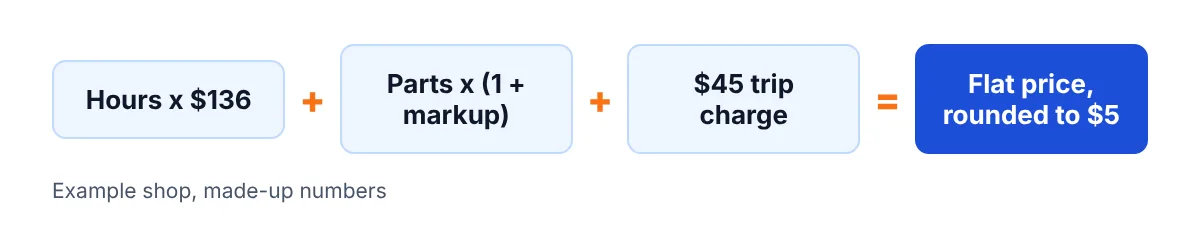
To price a plumbing job, multiply the task hours by your billable rate, add parts at your markup, add a trip charge, then round. A one-hour drain clearing at $136 an hour with a $45 trip charge comes to $180 in our example shop. The same six steps work for every service job.
How do plumbers charge for a job?
Plumbers charge for a job by the hour, by a flat price set before work starts, or by a bid on larger projects. With hourly billing, the customer carries the time risk. With a flat price, the shop carries it, so the price needs an honest hour estimate behind it. If you’re weighing which method fits which work, see the flat rate vs hourly comparison. The method below builds a flat price, and it also hands you a fair number to quote on an hourly job.
The 6-step method to estimate a plumbing job
A plumbing job estimate needs six inputs: your billable rate, honest hours, parts, a trip charge, your options and a final check. Every example on this page uses the same example shop, with made-up numbers.
Step 1: Know your billable rate
Start from what an hour really costs your shop, using the plumber labor rate calculator. Here’s what goes in for the example shop: 3 techs at $32.00 an hour, 12% payroll burden, 60% billable hours, $210,000 of overhead including the owner’s pay, and a 15% target net margin. What comes out is a $115.82 break-even and a $136 billable rate.
Step 2: Time the job honestly
Use your own job history for hours. Count the whole visit on site: setup, shutoff, the work, testing and cleanup. No records yet? Use a published range as a placeholder and swap it out as you collect real times. The plumbing job times table lists published ranges with sources and shows how to time your own work.
The hours on this page are example starting points. No working plumber has checked FlatPriced’s starter hours yet, so replace them with your own.
Scope counts too. On a new drain run, the 135 rule can call for an extra cleanout, so check your local code before you set the hours.
Step 3: Price the materials
Take what you really pay at the supply house and put a markup on it that fits the part, as covered on the plumbing markup calculator page. The examples below use these made-up inputs: 100% on an $18 part, 60% on a $120 faucet, 50% on a $220 pump and 40% on an $850 water heater.
Step 4: Add your trip charge
Add the cost of getting a truck to the door, which is $45 built into each price in the example shop. The plumbing service call cost guide covers how to set that charge, your minimum and any weekend premium.
Step 5: Build your options
Offer more than one way to solve the problem where the job allows it, and price each option with the same formula. See good, better, best options for plumbers for how many to show and how to present them.
Step 6: Round and sense-check
Round to the nearest $5, then run two checks before the price goes in the book. First, find your margin: (flat price minus break-even labor minus parts cost) / flat price. Second, find how long the job can run before it stops covering costs: (flat price minus parts cost) / your break-even rate.
5 worked examples of plumbing job pricing
Each example below uses $136 an hour, a $45 trip charge and rounding to the nearest $5, and all parts costs are made up. These are example prices and not market rates.
Toilet fill valve replacement: $185
We found no pro source that publishes a time for this job, so the 0.75 hours here is a stand-in to replace with your own.
| Line | Arithmetic | Amount |
|---|---|---|
| Labor | 0.75 hours x $136 | $102 |
| Parts | $18 x 2.00 (100% markup) | $36 |
| Trip charge | $45 | |
| Raw total | $183 | |
| Flat price | Rounded to $5 | $185 |
Now check it: cost is (0.75 x $115.82) + $18 = $105, so margin is ($185 minus $105) / $185 = 43%.
Bathroom faucet replacement: $440
HomeAdvisor lists 1 to 2 hours, so 1.5 hours sits in the middle.
| Line | Arithmetic | Amount |
|---|---|---|
| Labor | 1.5 hours x $136 | $204 |
| Parts | $120 x 1.60 (60% markup) | $192 |
| Trip charge | $45 | |
| Raw total | $441 | |
| Flat price | Rounded to $5 | $440 |
Check: cost is (1.5 x $115.82) + $120 = $294, so margin is ($440 minus $294) / $440 = 33%.
Drain clearing, single fixture: $180
Mr. Rooter puts drain cleaning at about 30 minutes to an hour, with severe blockages taking several hours or a full day. So a flat price needs a line for what happens when the job turns out severe. Say right in the price book that it covers one accessible fixture drain.
| Line | Arithmetic | Amount |
|---|---|---|
| Labor | 1.0 hour x $136 | $136 |
| Parts | None | $0 |
| Trip charge | $45 | |
| Raw total | $181 | |
| Flat price | Rounded to $5 | $180 |
Check: cost is 1.0 x $115.82 = $116, so margin is ($180 minus $116) / $180 = 36%.
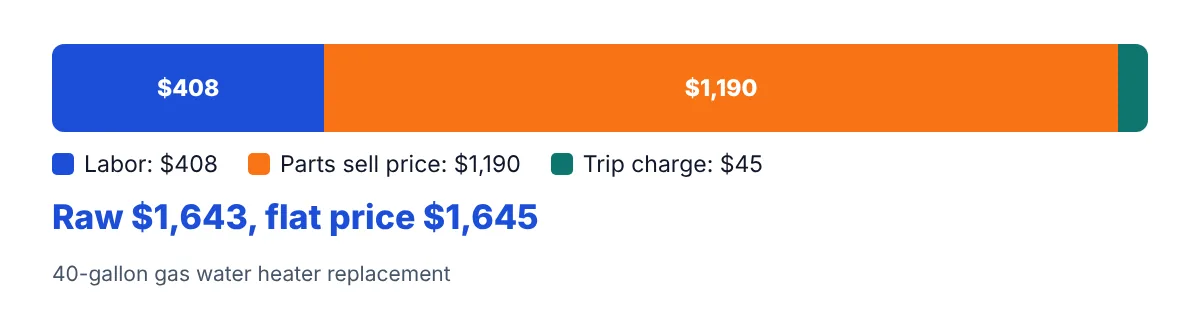
40-gallon gas water heater replacement: $1,645
Mr. Rooter and Thumbtack both list about two to three hours, and the example uses the high end. Thumbtack adds that tight spaces or extra repairs can take about four to eight hours.
| Line | Arithmetic | Amount |
|---|---|---|
| Labor | 3.0 hours x $136 | $408 |
| Parts | $850 x 1.40 (40% markup) | $1,190 |
| Trip charge | $45 | |
| Raw total | $1,643 | |
| Flat price | Rounded to $5 | $1,645 |
Check: cost is (3.0 x $115.82) + $850 = $1,197, so margin is ($1,645 minus $1,197) / $1,645 = 27%.
Sump pump replacement: $645
Angi says about 1 hour and Fixr says 1 to 3 hours, so sources differ. The example uses 2.0 hours.
| Line | Arithmetic | Amount |
|---|---|---|
| Labor | 2.0 hours x $136 | $272 |
| Parts | $220 x 1.50 (50% markup) | $330 |
| Trip charge | $45 | |
| Raw total | $647 | |
| Flat price | Rounded to $5 | $645 |
Check: cost is (2.0 x $115.82) + $220 = $452, so margin is ($645 minus $452) / $645 = 30%.
How to sense-check a plumbing price
A plumbing price passes the sense check when it covers cost at the hours you expect and still covers cost if the job runs long. This table runs both tests on the five examples.
| Job | Flat price | Expected hours | Margin after labor, overhead and parts | Hours before the job stops covering cost |
|---|---|---|---|---|
| Toilet fill valve | $185 | 0.75 | 43% | 1.4 |
| Drain clearing | $180 | 1.0 | 36% | 1.6 |
| Bathroom faucet | $440 | 1.5 | 33% | 2.8 |
| Sump pump | $645 | 2.0 | 30% | 3.7 |
| Water heater | $1,645 | 3.0 | 27% | 6.9 |
The last column is (flat price minus parts cost) / $115.82. Run it for the water heater: $795 / $115.82 = 6.9 hours. That sits right inside Thumbtack’s four to eight hours for a hard install. So one tight closet could eat the whole margin, and the shop may want a separate price line for it.
Margin percent falls as parts grow, and that’s normal for big-ticket work. The water heater earns the lowest percent and the most dollars: $448, against $80 on the fill valve. So judge a job on both, the percent and the dollars.
No independent US benchmark for plumbing margin turned up in our research, and vendor opinions differ, so set your target from your own numbers. The plumbing markup calculator page lists the published figures.
Two jobs on one ticket follow a different rule, because the second one doesn’t need its own trip. See pricing multiple jobs on one visit.
Price your own job with the free calculator
The flat rate price calculator runs this formula with your numbers, and it works today with no sign-up. FlatPriced is being built to run the same formula across a whole price book, and it’s in pre-launch.
FAQs
How do I charge for a plumbing job?
Charge for a plumbing job by adding labor, parts and the cost of getting there. Multiply task hours by your billable rate, add parts at your markup, add a trip charge, then round. In our example shop, a 1.5-hour faucet job at $136 an hour with $120 of parts at 60% markup and a $45 trip charge comes to $440.
How do you estimate a plumbing job?
Start by listing the work, then assign hours and parts to each piece. Use your own job history for hours, or a published range as a placeholder. Get real parts costs from your supply house. Add your trip charge and any known access problems. If you can’t see the scope, quote a diagnostic first and price the job after that.
How much do plumbers charge per job?
We can’t give a reliable national price per job, because our sources publish hourly rates and fees far more than job prices. The answer depends on hours, parts and the shop’s rate. Our example shop, with made-up numbers, charges $180 to clear one drain, $440 for a bathroom faucet and $1,645 for a 40-gallon gas water heater. Those aren’t market rates.
How do you price commercial plumbing jobs?
Commercial service work uses the same formula with your own commercial rate. Housecall Pro’s published figures start around $100 an hour for commercial work, with master plumbers up to $200. Larger jobs bid from plans need a material takeoff, which is a separate process from this one. This guide and FlatPriced are aimed at service and repair work and not new construction.
What should you do when a job takes longer than the flat price assumed?
Honor the price you quoted, unless the scope changed. A flat price means the shop carries the time risk on the agreed work. If you open it up and find something new, such as a rotted shutoff or a blocked access panel, stop and quote the added work before doing it. Log the real hours, then update the book if the job keeps running long.
Sources
- How long does a plumber take, Mr. Rooter, 28 Sep 2023
- How long does it take to install a water heater, Thumbtack, undated, seen 3 Nov 2026
- Cost to replace a bathroom faucet, HomeAdvisor, titled 2025
- Sump pump replacement cost, Angi, 22 Nov 2024
- Sump pump installation cost, Fixr, 31 Jan 2025