
Plumbing flat rate pricing guide for 2026
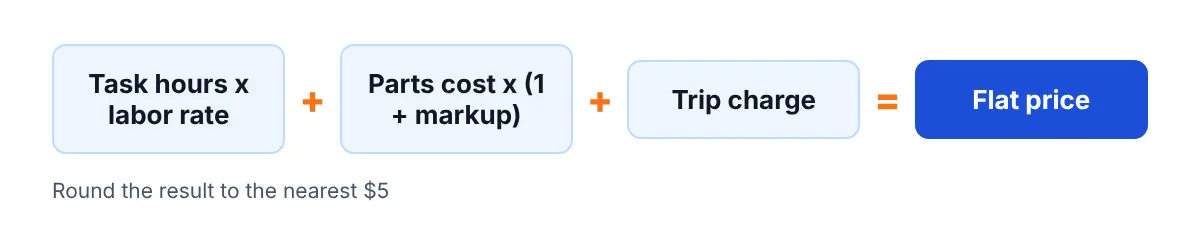
Flat rate pricing means a plumber quotes one fixed price for a job before work starts, and that price holds if the job runs long. Each price comes from task hours times a labor rate, plus marked-up parts and a trip charge. It suits repeat repairs with a known scope.
What is flat rate pricing for plumbers?
Flat rate pricing for plumbers is a way of charging by the job instead of by the clock. The homeowner hears one price for a fill valve, a disposal or a water heater, says yes, and pays that amount. Some shops call it upfront pricing.
Flat rate doesn’t throw out your hourly rate. You just do the hourly math before the job instead of after it. Anja Smith, writing in Plumber Magazine on 2 Jul 2018, described her shop’s book as still using its own hourly rate times the time for the job. The difference is who sees the math and when. For the side-by-side, including when hourly is the better call, see the flat rate vs hourly comparison.
How does flat rate pricing work?
Flat rate pricing works by setting prices ahead of time, then quoting from that list on site.
- The owner sets a price for each common job and keeps the prices in a book, a sheet or an app.
- The tech arrives, diagnoses the problem and matches it to a job in the book.
- The customer sees the price and approves it before work starts.
- The tech does the work. If the job runs long, the shop eats the time. If it runs short, the shop keeps the difference.
Now say your tech pulls a toilet and finds a rotted closet flange under it. The job just changed. So stop, price the new work, and get a new approval.
The flat rate formula
The flat rate formula is task hours times labor rate, plus parts cost with markup, plus a trip charge, rounded to the nearest $5. Four inputs decide whether the price makes money.
Labor rate
The labor rate in the formula is a billing rate that covers pay, burden, unbilled time, overhead and profit. The Bureau of Labor Statistics puts median pay for plumbers, pipefitters and steamfitters at $30.67 an hour (May 2025), which is a wage and not a billing rate. The plumber labor rate calculator works out yours.
Our example shop has 3 techs at $32 an hour, 12% burden, 60% billable time, $210,000 of overhead and a 15% target net margin. Run those numbers and you get a break-even of $115.82 and a billable rate of $136 an hour (example shop, made-up numbers).
Task hours
Task hours are the time a job takes in your shop, on your kind of housing. Your own job history beats any published number. Anja Smith reported in 2018 that her book’s task times matched her dispatch calendar about 90% of the time. That’s one shop’s check, so run your own.
Parts and markup
Parts go in at your cost plus a markup, and the markup usually falls as the part gets more expensive. The plumbing markup calculator converts markup to margin so you can see what you keep.
Trip charge
In this formula the trip charge is built into the price, so the customer sees one number. To set one, use the service call fee guide.
Worked example: water heater replacement
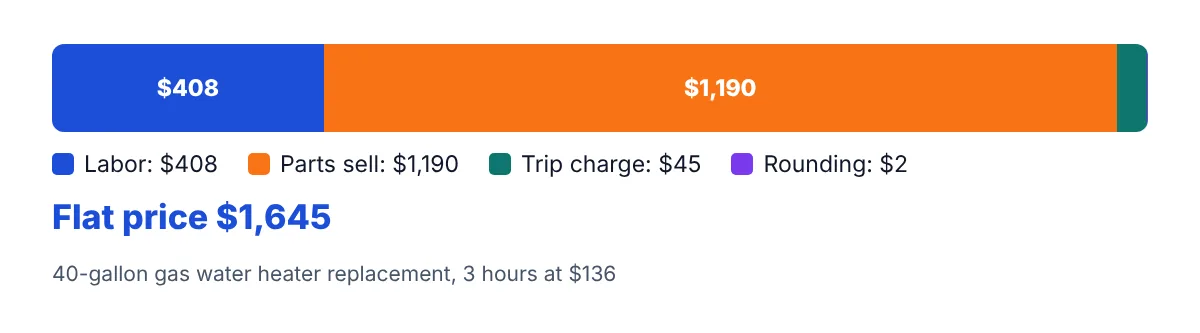
A 40-gallon gas water heater replacement comes to $1,645 in our example shop. The inputs are 3 hours, $850 in parts at a 40% markup, and a $45 trip charge (example shop, made-up numbers). Work it one line at a time.
- Labor: 3 x $136 = $408
- Parts: $850 x 1.40 = $1,190
- Trip charge: $45
- Raw total: $408 + $1,190 + $45 = $1,643
- Flat price, rounded to the nearest $5: $1,645
Now check the margin, because the price alone won’t tell you whether the job made money. At the $115.82 break-even rate, the job costs 3 x $115.82 + $850 = $1,197. Take that off the $1,645 and you’ve got $448, or 27% of the price, left after labor, overhead and parts. The free flat rate price calculator runs this math on your own numbers with no account.
Flat rate plumbing prices: four examples
Flat rate plumbing prices run from under $200 to well over $1,000 in the same book, because the parts and hours differ so much. These four come from the example shop at $136 an hour with a $45 trip charge. They’re made-up numbers to show the method, so don’t copy them as market rates.
| Job | Hours | Parts cost | Markup | Flat price | Margin after overhead |
|---|---|---|---|---|---|
| Toilet fill valve replacement | 0.75 | $18 | 100% | $185 | 43% |
| Garbage disposal replacement | 1.5 | $140 | 60% | $475 | 34% |
| Toilet replacement, customer-grade toilet | 2.0 | $190 | 50% | $600 | 30% |
| 40-gallon gas water heater replacement | 3.0 | $850 | 40% | $1,645 | 27% |
Typical ranges to check your numbers against
Published plumbing ranges are wide, and every one we found comes from a vendor, a cost guide or trade press. Use them to sanity-check your inputs and nothing more. None of them is a flat price for your market.
| Input | Published range | Source |
|---|---|---|
| Residential hourly rate, standard work | $75 to $150 | Housecall Pro, Plumbing prices 2026 |
| Service call | $50 to $250 | Housecall Pro, same page |
| After-hours multiplier | 1.5 to 3 times | Housecall Pro, same page |
| Parts markup | 400%+ on small items, 50% to 75% mid-range, 25% to 40% big-ticket | Plumber Magazine, 2 Jan 2025 |
| Net margin, vendor opinion | 5% to 12% typical (Housecall Pro); 10% to 20% reasonable (ServiceTitan) | Housecall Pro, 13 May 2026; ServiceTitan, 16 Oct 2026 |
We found no independent US benchmark for plumbing margins, so treat the last row as opinion. For more on market rates, see the guide to what plumbers charge per hour.
Pros and cons of flat rate pricing
The main benefit of flat rate pricing is that the customer knows the price before work starts, and the main risk is that a bad number gets repeated on every job.
| Benefits | Drawbacks |
|---|---|
| Customer approves a known price before work starts | The price is only as good as your rate and hours. Anja Smith wrote in 2019 that if the rate leaves no room for profit, there won’t be any profit |
| A fast tech doesn’t cut the shop’s revenue on a job | It depends on accurate diagnosis up front |
| No clock-watching from the customer | Invoices carry less detail, which makes job costing harder |
| Same job gets the same price from every tech | A book that tries to cover every variation gets too big to use |
| Slow jobs stop being the customer’s problem | The shop carries the overrun when a job runs long |
You may be worried about looking like you’re overcharging. Smith was too. In her 2018 article, she listed that fear, along with price stacking and turning plumbers into salespeople, among the objections she had before converting.
How to switch from hourly to flat rate
Switching from hourly to flat rate takes six steps, and most of the work happens before the first flat quote goes out.

Step 1: Find your real labor rate
Work out your break-even and billable rate from your actual payroll and overhead. If you guess at the rate, that guess carries into every price in the book.
Step 2: Price your 20 most common jobs
Pull last year’s invoices, rank the jobs by how often you sold them, and price the top 20. The guide to building a price book has the full method.
Step 3: Check the hours against past jobs
Compare your book hours with what the dispatch calendar shows those jobs actually took. Fix the ones that are off before a customer sees them.
Step 4: Decide what stays hourly
Keep time and materials for work you can’t scope, such as an unknown leak behind a wall. Aptora’s blog advises keeping T&M for troubleshooting and commercial work.
Step 5: Train techs to quote first
Sit your techs down, tell them why you’re changing, and have them practice. Aptora’s advice is to present the findings and get approval before work starts, which avoids sticker shock on the invoice.
Step 6: Review after the first month
Compare book hours with actual hours on the jobs you sold. Fix the ones that are way off, then add the next batch of jobs.
Four decisions to make before your first flat quote
Four pricing decisions come up as soon as flat quotes go out, and each one has its own guide.
- Two jobs on one visit. Stacking two full prices can feel like overcharging. See pricing multiple jobs on one visit.
- Fees on top of the price. Several states now require mandatory fees in the advertised price. See all-in pricing and junk fee laws, which is general information and not legal advice.
- Moving parts costs. PM Magazine’s April roundup listed a 10% Charlotte Pipe increase on PVC and CPVC, so a flat price can go stale. See how to update prices when materials rise.
- “Why so much?” Customers will ask, so have an answer ready. See how to explain a flat rate price.
FlatPriced is in pre-launch and is being built to do this math from a phone, using your own rates. The plumbing flat rate software page has the planned features.
FAQs
What is flat rate pricing?
Flat rate pricing is charging one fixed price for a defined job, set before the work starts, instead of billing hours and materials afterward. In plumbing, the price usually comes from task hours times a labor rate, plus parts with markup and a trip charge. The customer approves the price first, and it holds if the job runs long.
How does flat rate pricing work for plumbers?
A plumbing shop sets a price for each common job ahead of time and keeps the prices in a book or app. The tech diagnoses the problem, finds the matching job and quotes that price. The customer approves before work starts. The shop eats any overrun, and if the scope changes, the tech stops and quotes the new work.
What are the benefits of flat rate pricing?
The benefits are a known price before work starts, consistent prices across techs, and no clock-watching. A fast tech doesn’t cut the shop’s revenue, and customers don’t carry the cost of a job that runs long. Those benefits depend on accurate rates and hours. A flat price built on a bad labor rate repeats the same loss on every job.
Does flat rate cost customers more than hourly?
Sometimes it does and sometimes it doesn’t, and we found no independent study that settles it. The flat rate vs hourly comparison runs one job at three durations, so you can see when each method comes out higher for the customer and who carries the time.
What happens if a flat rate job takes longer than expected?
If the scope is the same, the shop keeps the price and absorbs the extra time. That’s the deal with the customer. If the tech finds new work that wasn’t in the quote, such as a seized shut-off or a rotted flange, the tech should stop, explain it, price the change and get a new approval before continuing.
Should plumbers use flat rate on every job?
No. Flat rate fits repeat jobs with a known scope, such as a disposal swap or a toilet replacement. Work you can’t scope up front, like tracing an unknown leak, can stay on time and materials. Aptora’s blog advises keeping T&M for troubleshooting and commercial work, and a shop can use both methods side by side.
Sources
- Plumber Magazine, Confessions of a flat rate pricing convert, 2 Jul 2018
- Plumber Magazine, Is flat rate pricing the silver bullet you’re looking for, 15 Jul 2019
- Plumber Magazine, Mastering margins in the plumbing trade, 2 Jan 2025
- Bureau of Labor Statistics, Occupational Outlook Handbook, modified 29 Oct 2026
- Housecall Pro, Plumbing prices 2026, seen 3 Nov 2026
- Housecall Pro, plumbing business profitability, 13 May 2026
- ServiceTitan, plumbing business profitability, 16 Oct 2026
- Aptora, common flat rate pricing mistakes, seen 3 Nov 2026
- PM Magazine, PHCP PVF price increases April 2026, 2 Apr 2026