
Flat rate vs hourly: which pricing fits plumbers in 2026
Flat rate fits plumbing jobs with a known scope, because the customer gets a fixed price and the shop carries the time risk. Hourly fits work you can’t scope, because the customer pays for the time it takes. A shop can use both. We found no independent study showing either one earns more.
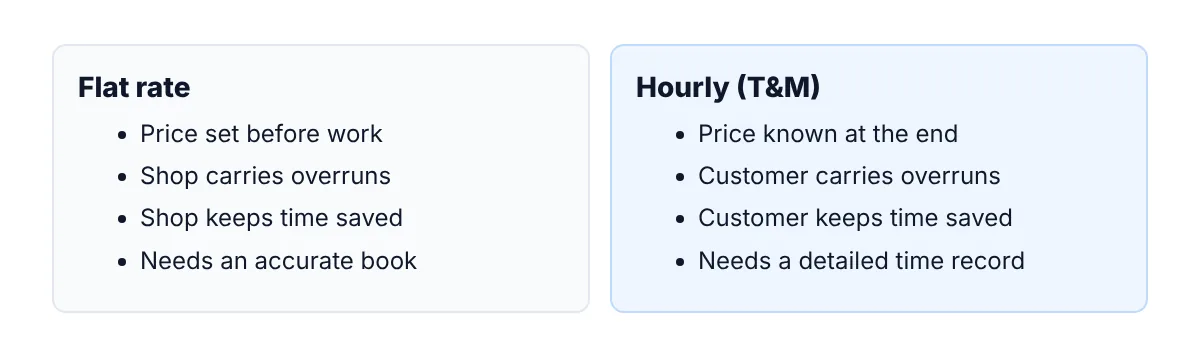
Flat rate vs hourly pricing compared
The difference between flat rate and hourly is when the price gets set and who carries the risk of a job running long. Flat rate sets the price before work and puts the time risk on the shop. Hourly, also called time and materials or T&M, sets the bill after the work and puts that risk on the customer.
| Flat rate | Hourly (T&M) | |
|---|---|---|
| When the customer knows the price | Before work starts | When the job ends |
| Who carries an overrun | The shop | The customer |
| Who gains from a fast job | The shop | The customer |
| What you need first | A book built on real rates and hours | A posted rate and a record of time |
| Invoice detail | One price, less detail | Hours and parts listed |
| Tech skill it leans on | Diagnosis before quoting | Accurate time and parts tickets |
| Best fit | Repeat repairs and replacements | Troubleshooting and unknown scope |
Flat rate doesn’t mean a different hourly rate. Anja Smith described her shop’s book in Plumber Magazine on 2 Jul 2018 as still built on hourly rate times the time for the job. To see how those prices get built, read the flat rate pricing guide.
Worked example: one job, three durations
A toilet replacement shows the gap best when the same job takes different amounts of time. The example shop bills $136 an hour, its break-even rate is $115.82, the toilet costs $190 and sells for $285, and the trip charge is $45 (example shop, made-up numbers).
The flat price assumes 2 hours: (2 x $136) + $285 + $45 = $602, rounded to $600.
The hourly bill moves with the clock:
- 1.5 hours: (1.5 x $136) + $285 + $45 = $534
- 2 hours: (2 x $136) + $285 + $45 = $602
- 3 hours: (3 x $136) + $285 + $45 = $738
The job’s cost moves too. Take the hours x $115.82, add the $190 for parts, and you get $364, $422 and $537.
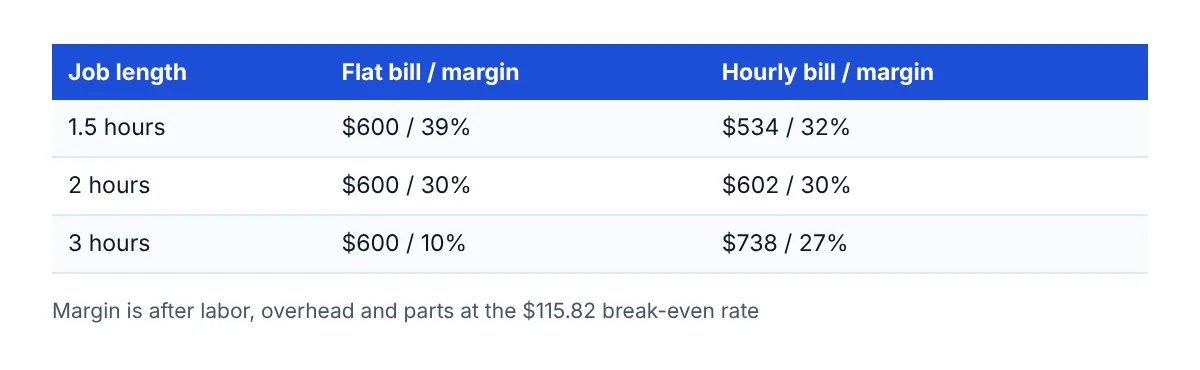
At the planned 2 hours, both methods land in the same place. When the job runs short, flat rate earns the shop more. Now let it run to 3 hours. The flat margin falls to 10% while the hourly margin holds at 27%, because the customer paid for the extra hour. So under flat rate, accurate hours matter a lot, because bad hours repeat on every job. The flat rate price calculator lets you run this on your own numbers.
When flat rate fits
Flat rate fits jobs you can see, scope and price before you start. That covers most residential service repairs and swaps.
- A fill valve, angle stop or hose bibb swap
- A disposal, faucet or toilet replacement
- A like-for-like water heater replacement
- Single-fixture drain clearing with normal access
It also suits shops where customers want a number before they say yes, and where more than one tech quotes. Two techs quoting from one book give the same price for the same job, so it doesn’t matter which one shows up.
When hourly or T&M fits
Hourly or T&M pricing fits work where nobody can say how long it will take until the work is underway. Aptora’s blog advises keeping T&M for troubleshooting and commercial work. Contractors on the Mike Holt forum said in 2022 and 2023 that service calls are harder to flat-rate because conditions are unknown. That’s a forum anecdote from our notes, not re-checked.
- Tracing an unknown leak or an intermittent problem
- Old galvanized work where one fitting can turn into ten
- Remodel work where the scope keeps changing
- Commercial work under a contract that sets T&M terms
You don’t have to choose once for the whole shop. One option is a set diagnostic charge or T&M to find the problem, then a flat price to fix it. Tell the customer which one applies before you start.
Is flat rate better than hourly for a small shop?
Flat rate is better than hourly for a small shop when the shop’s work is mostly repeat jobs and the owner has real numbers behind the prices. Hourly is the safer choice until then. Build a flat book on a guessed rate and you’ll repeat the same mistake on every job. Anja Smith put it plainly in Plumber Magazine in 2019: if the hourly rate behind your prices leaves no room for profit, you won’t get any. So start with the plumber labor rate calculator.
The change can feel uncomfortable at first. One PlumbingZone poster in 2008 described a $575 flat bill sitting against a $295 T&M estimate, and said raising rates would make him feel like a thief. Smith said in 2018 that customers still come in with a set idea of what a plumbing job is worth. For those conversations, see the guide to explaining a flat price, and the guide to what plumbers charge per hour shows published market rates.
Cash flow under flat rate and hourly
Cash flow depends more on when you collect than on how you price, but flat rate makes collecting at the job easier. The customer has already approved a total, so there’s no waiting on time tickets before the invoice goes out, and a deposit is easy to work out on a larger job. A poster in an older r/HVAC thread called flat rate cash on delivery.
You can get paid on the spot for hourly jobs too. The bill just can’t be final until the work is done, and a customer surprised by the total can dispute it. Under either method, collecting at the end of the job does more for cash flow than the pricing model does.
Flat rate has one accounting cost. Smith noted in 2019 that less detailed invoices make job costing harder, so keep actual hours on the work order even if the customer never sees them.
Tech pay under flat rate and hourly
Tech pay doesn’t have to change when pricing changes. A shop can quote flat prices and keep paying techs an hourly wage, and the example shop’s $32 an hour stays $32. What changes is who gets the benefit of speed. For pay plans with worked numbers, see how to pay plumbers under flat rate.
| Pay setup | Under flat rate pricing | Watch for |
|---|---|---|
| Hourly wage | Simple, no change for techs | Fast work isn’t rewarded unless you add something |
| Hourly plus bonus | Bonus can be tied to call-backs or reviews | Keep the target simple |
| Commission on sales | Pay rises with sold work | Can push techs toward selling, which some techs object to |
Pay itself won’t fix a performance problem. Smith wrote in 2019 that flat rate won’t motivate an unmotivated employee. We found no independent data on which pay setup works best for small plumbing shops, and wage rules differ by state, so check commission or piece-rate plans with your payroll provider or a lawyer.
Some techs worry about feeling like salesmen. Forum posters raise it often, and Smith listed it among the objections she had before converting. Train your techs to explain the options plainly, and let the customer decide.
FAQs
What is better, hourly or flat rate?
Neither is better for every job. Flat rate works for repeat repairs with a known scope, because the customer gets a fixed price and the shop carries the time risk. Hourly works for troubleshooting and unknown scope, because the customer pays for the time it takes. We found no independent study showing which earns more, and a shop can use both.
What is the difference between flat rate and hourly?
Flat rate sets one price before the work starts, and that price holds if the job runs long. Hourly bills the time and materials used after the work is done, so the final amount isn’t known until the end. Both can use the same labor rate and parts markup. The real difference is who carries the risk of overruns.
Is flat rate more expensive for the customer?
Not always. On a job that takes the planned time, flat and hourly bills built from the same rate come out about the same. In our example shop, a 2-hour toilet replacement is $600 flat and $602 hourly. The flat price is higher when the job runs short and lower when it runs long, and these are made-up numbers.
Can a plumbing shop use both flat rate and hourly?
Yes. One setup is flat prices for repeat jobs, and T&M for troubleshooting, unknown leaks or commercial work. Decide in advance which jobs go where, and tell the customer which applies before work starts. You can also charge T&M or a set fee to find the problem, then quote a flat price to fix it.
Does flat rate pricing change how techs get paid?
No, flat rate pricing doesn’t have to change tech pay. A shop can quote flat prices and keep paying an hourly wage, so a tech on $32 an hour stays on $32 an hour. Some owners add a bonus or commission, but we found no independent data on which setup works best. Check wage rules for your state first.
Sources
- Plumber Magazine, Confessions of a flat rate pricing convert, 2 Jul 2018
- Plumber Magazine, Is flat rate pricing the silver bullet you’re looking for, 15 Jul 2019
- Aptora, common flat rate pricing mistakes, seen 3 Nov 2026
- PlumbingZone, Flat Rate Price Book – HELP!!!, 2008
- Mike Holt Forum, hourly rate, service call, flat rate, Dec 2022 to Jan 2023
- r/HVAC, “Flat Rate vs T&M”, older thread, read through search results