
How much do plumbers markup materials? Free calculator
Published plumbing material markups run from about 25% on big-ticket items to 400% or more on small parts, and we found no single standard. Put in a parts cost and a markup or margin, and this calculator shows you the sell price, profit and multiplier. No email needed.
Published plumbing material markup ranges
Published plumbing material markup figures vary widely, and most come from vendors or trade press. We found no independent survey. What the two trade press sources do agree on: smaller parts get the higher percentages.
| Source | What it says | Type and date |
|---|---|---|
| Plumber Magazine | Small items 400% or more; mid-range 50% to 75%; big-ticket 25% to 40% | Trade press, 2 Jan 2025 |
| PM Magazine | Install materials 25% to 50%; spare parts at least 100% on average; 50-cent to $10 items 200% to 400%; $25 to $50 items 50% to 75% | Trade press, 29 Dec 2000 (old) |
| Housecall Pro | 25% to 50%, no source given | Vendor, 13 May 2026 |
| ServiceTitan | Best practice of 3X to 6X cost | Vendor, 23 Aug 2023 |
| Mike Holt forum | Posters reported 40% to 110% | Forum anecdote, 2021, not re-verified |
Do the math on ServiceTitan’s 3X to 6X and you get a 200% to 500% markup, well above the mid-range and big-ticket figures from other sources. Read all of these as opinions.
Markup vs margin
Markup is profit as a share of cost, and margin is profit as a share of the sell price. Put them on the same part and you get two different numbers, and margin is always the smaller one. Mix them up and you underprice the job. Housecall Pro’s example shows it: a 25% markup on a $750 job is $937.50, but a 25% margin on that job needs $1,000.
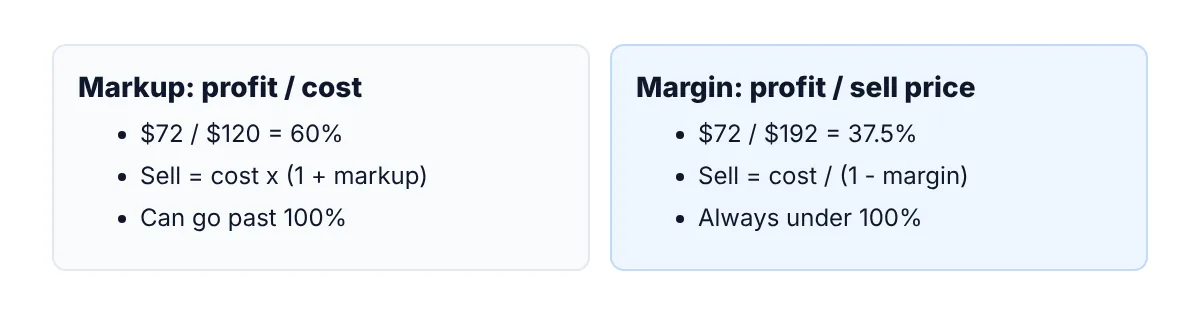
The calculator works it both ways. Type a markup and the margin updates. Type a margin and the markup updates.
Markup, margin and multiplier table
A multiplier is 1 plus the markup, so a 60% markup is a 1.60x multiplier. The table below is plain arithmetic, so don’t read it as a recommendation.
| Markup | Multiplier | Margin | $100 part sells for |
|---|---|---|---|
| 25% | 1.25x | 20.0% | $125 |
| 40% | 1.40x | 28.6% | $140 |
| 50% | 1.50x | 33.3% | $150 |
| 60% | 1.60x | 37.5% | $160 |
| 100% | 2.00x | 50.0% | $200 |
| 200% | 3.00x | 66.7% | $300 |
| 400% | 5.00x | 80.0% | $500 |
Worked example: setting parts tiers
A tiered markup charges a higher percentage on cheap parts and a lower one on expensive parts. The example shop uses four tiers on its jobs. These numbers are made up to show how it works, so they aren’t market rates or a recommendation.
| Example part | Parts cost | Markup | Sell price | Profit on part | Margin |
|---|---|---|---|---|---|
| Toilet fill valve | $18 | 100% | $36 | $18 | 50.0% |
| Bathroom faucet | $120 | 60% | $192 | $72 | 37.5% |
| Customer-grade toilet | $190 | 50% | $285 | $95 | 33.3% |
| 40-gallon gas water heater | $850 | 40% | $1,190 | $340 | 28.6% |
Look at the water heater. It has the lowest percentage and the most dollars of profit.
Now here’s the classic mistake. Say the shop wants a 40% margin on the $120 faucet. Work it out: $120 / (1 – 0.40) = $200, so that’s the right sell price, and it’s a 66.7% markup. But type 40 in the markup box by mistake and you get $168, and now you’re at a 28.6% margin and $32 less on every faucet.
To put a markup into a full job price, use the flat rate price calculator. Your tiers belong in your plumbing price book. When supply house prices move, you’ll need to go back to them, and the guide on updating material costs explains how.
How to use this plumbing supply markup calculator
This calculator has three inputs and five results, and it opens with a $120 part at 60% markup. Press Load example any time to get back to those numbers.
- Enter the parts cost, meaning what you pay at the supply house.
- Enter either a markup % or a margin %. Changing one updates the other.
- Read the sell price, gross profit on the part, multiplier, markup and margin.
- Press Copy link to these numbers to save the inputs in a web address.
FAQs
How much should I upcharge for materials?
There’s no single right figure. Published ranges include 25% to 40% on big-ticket items and 400% or more on small items, per Plumber Magazine in January 2025. Plumber Magazine and PM Magazine both set tiers by part cost. Check your choice against your target margin and against your own labor rate, then adjust for what your market will accept.
What is a good profit margin for plumbing?
We found no independent US benchmark. ServiceTitan’s view is 60% to 62% gross and 10% to 20% net. Housecall Pro reports 5% to 12% net as typical, citing Profitability Partners. Both are vendor sources. Canadian government data for 2024 implies about 11.2%, and it includes HVAC.
What is the difference between markup and margin?
Markup is profit divided by cost, and margin is profit divided by sell price. A $120 part sold at $192 earns $72, which is a 60% markup and a 37.5% margin. Use markup to set a price from a parts cost, and use margin to compare a price with your target profit.
How do I convert a margin to a markup?
Divide the margin by 1 minus the margin. A 40% margin is 0.40 / 0.60, which is a 66.7% markup. Going the other way, divide the markup by 1 plus the markup, so a 60% markup is 0.60 / 1.60, or 37.5%. The calculator on this page does this conversion in both directions as you type.
Is parts markup the same on every job?
It doesn’t have to be. Plumber Magazine and PM Magazine give lower percentages for big-ticket items and higher ones for small parts, and the example shop uses 100% on an $18 fill valve and 40% on an $850 water heater. Those numbers are made up. Keep your tiers simple enough that every tech can run them the same way.
Sources
- Plumber Magazine, Mastering margins in the plumbing trade, 2 Jan 2025
- PM Magazine, Material markup, 29 Dec 2000
- Housecall Pro, plumbing business profitability, 13 May 2026
- ServiceTitan, plumbing material markup, 23 Aug 2023
- Mike Holt Forum, upfront pricing thread, 2021
- Housecall Pro, how to price plumbing jobs, seen 3 Nov 2026
- ServiceTitan, plumbing business profitability, 16 Oct 2026
- Innovation, Science and Economic Development Canada, NAICS 23822 performance data, 2024 data