
Plumbing price book: what it is and what goes in one
A plumbing price book is a shop’s list of common jobs, each with a set price built from labor hours, parts cost and markup. Your techs use it to quote the same number for the same job, no matter who’s on the truck. You’ll also hear it called a flat rate book, a pricebook or a pricing manual.
Status, November 2026: FlatPriced is in pre-launch and taking founding customers. The app described here is being built, so features and prices may change before release. The free calculators work today.
Use the free calculator | Join the founding list
What is a plumbing price book?
A plumbing price book is the reference that turns “how much?” into one fixed answer before work starts. A flat rate plumbing price book replaces the hourly clock with a total for the job, so the customer knows the price and the tech doesn’t have to do math in a basement.
A plumbing pricing book can live on paper, in a spreadsheet or in an app. Honestly, the format matters less than the numbers inside. Every line should trace back to your labor rate, your job times and what you pay at the supply house.
A national book gives you a format and a job list, but its hours and parts assumptions came from somewhere else, and that somewhere isn’t your shop. So treat them as a starting point until your own numbers replace them. The step-by-step process is in the guide to building a book from scratch.
What goes in a plumbing service price book
A plumbing service price book holds five things for each job: a task name, a time, parts with markup, a price, and any options. Get the columns below in there and a tech can quote from the book without calling the office.
Task list by category
Group jobs the way techs think on a service call: drains, toilets, faucets and fixtures, water heaters, water lines and valves, disposals, sump and outdoor. Name each job in words the homeowner understands, such as “replace angle stop” or “replace toilet fill valve”.
Task times
Each job needs hours, and those hours drive most of the price on repair work. Your own history is the best source you’ve got. Published job time ranges can fill gaps, but they’re written for homeowners and they disagree: toilet installs are listed at 1 to 2 hours by Ace and 2 to 4 hours by Bob Vila.
Materials and markup
List the parts for each job at what you pay, then apply your markup. Plumber Magazine’s January 2025 ranges run from 25% to 40% on big-ticket items up to 400% or more on small items. The plumbing markup calculator converts any markup to margin.
Trip charge
Decide once how you’ll handle the trip charge, then do it the same way on every line. The sample below builds it into the price, so the customer sees one number.
Options and member prices
Many books add Good, Better and Best versions of a job, for example a standard or premium faucet. Shops with maintenance plans often add a member price column. FlatPriced plans three options on every plan, but member pricing isn’t on the Version 1 feature list.
Sample plumbing price book page
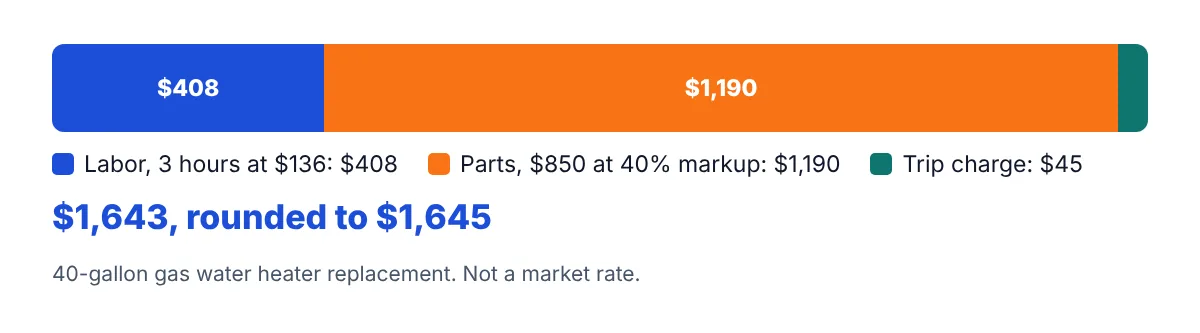
A sample plumbing price book page shows how hours, parts and markup become a price. The page below uses an example shop at $136 an hour, a $45 trip charge built in, and rounding to the nearest $5. These are made-up numbers, not market rates, so don’t copy the prices.
| Job | Hours | Parts cost | Markup | Flat price | Margin after overhead |
|---|---|---|---|---|---|
| Toilet fill valve replacement | 0.75 | $18 | 100% | $185 | 43% |
| Bathroom faucet replacement | 1.5 | $120 | 60% | $440 | 33% |
| Toilet replacement, customer-grade toilet | 2.0 | $190 | 50% | $600 | 30% |
| Garbage disposal replacement | 1.5 | $140 | 60% | $475 | 34% |
| Drain clearing, single fixture | 1.0 | $0 | 0% | $180 | 36% |
| Sump pump replacement | 2.0 | $220 | 50% | $645 | 30% |
| 40-gallon gas water heater replacement | 3.0 | $850 | 40% | $1,645 | 27% |
Margin here is what’s left after hours at the shop’s $115.82 break-even rate and parts at cost. No working plumber has checked these hours, so replace them with your own job history. Want to run one line with your own numbers? Use the flat rate price calculator.
Paid book vs free template vs software
Disclosure: We make FlatPriced, a competing product that is still in pre-launch. Facts about other products come from the sources listed at the end of this page. Prices change, so confirm them with the vendor.
A paid book gives you content, a free template gives you a cheap start, and software gives you repricing and quoting from the field. Costs below are as listed on 3 Nov 2026.
| Option | Listed cost | What you get | Watch for |
|---|---|---|---|
| Paid book or subscription | Aptora prebuilt Plumbing book: $1,800 one time. Profit Rhino: $39 to $59 per tech a month, with subpages showing $35 to $55. The New Flat Rate: from $99 per tech a month | Ready-made jobs and content, in some cases maintained by the vendor | Per-tech cost, required coaching at Profit Rhino, hours you didn’t time |
| Free template | FlatPriced template: $0, no email needed. LeadDuo builder: no account to start, PDF and CSV export needs a paid pass | A job list and formulas you control | You keep parts costs current by hand |
| Software | Aptora Forever Free or $50 a month per user. FlatPriced planned at $0, $39 and $69 a month per shop, founding prices that may change | Bulk price updates and phone quoting | Limits on free plans. Check which exports each plan includes |
Give credit where it’s due: paid vendors are stronger on ready-made content. Profit Rhino claims its book covers 90% of common repairs, which is a vendor claim. FlatPriced will start with about 100 jobs and no maintained parts content. For how the app is planned to work, see the plumbing flat rate software page.
Residential plumbing price book vs construction pricing
A residential plumbing price book covers repair and replacement work at an occupied home, where one tech can quote one job on the spot. New-construction work is a different animal. It’s bid from plans and depends on takeoff, so a service book doesn’t fit it, and FlatPriced isn’t built for it.
5 price book mistakes that cost plumbers money
Price book mistakes usually come from borrowed numbers, too many lines, or prices nobody revisits. The good news is that each of the five below is fixable with your own data.
1. Copying another shop’s prices
A copied price carries that shop’s rate. Take the example water heater. At $136 an hour it’s $1,645. Copy a book built at $120 and the same job comes to $1,595, so you give up $50 on every install.
2. Building on a rate with no profit in it
A book can’t add profit that its rate leaves out. Anja Smith made this point in Plumber Magazine on 15 Jul 2019. So work out your number with the plumber labor rate calculator before you price anything.
3. Loading thousands of jobs
A big book is slow to search and slow to maintain, and nobody wants to scroll through thousands of lines at the door. One ServiceTitan Community user reported deleting 23,000 unused Profit Rhino elements in May 2022.
4. Trusting hours nobody timed
Hours decide the labor line, so an unchecked time is an unchecked price. Anja Smith wrote in Plumber Magazine on 2 Jul 2018 that she compared her book’s times with the dispatch calendar and found them right 90 percent of the time. Run the same check on yours.
5. Letting parts costs go stale
Parts move faster than most books do. Say the example water heater’s parts rise 10% to $935. Leave the price at $1,645, and your margin falls from 27% to 22%. The guide on updating a book for material costs shows you how to fix that.
FAQs
What is a price book?
A price book is a shop’s reference list of jobs with a set price for each one. In plumbing, each price comes from labor hours, parts cost, markup and any trip charge. Techs quote from it so customers get the same price for the same job, whichever tech comes out, and everybody knows the price before work starts.
How many tasks should a plumbing price book have?
There’s no fixed number, and a shorter book is easier to keep current, so a small shop can start with the 20 to 40 jobs it sells most. The guide to building a price book covers how many jobs to start with and when to add more.
Can I copy another company’s book?
Copying another shop’s numbers is a poor plan, because its prices carry its labor rate, parts costs and job times, not yours. In the example, a book built at $120 an hour prices a water heater $50 below one built at $136. If you’re thinking of reusing a vendor’s book, read its license terms or ask a lawyer first.
What is the difference between a price book and a price list?
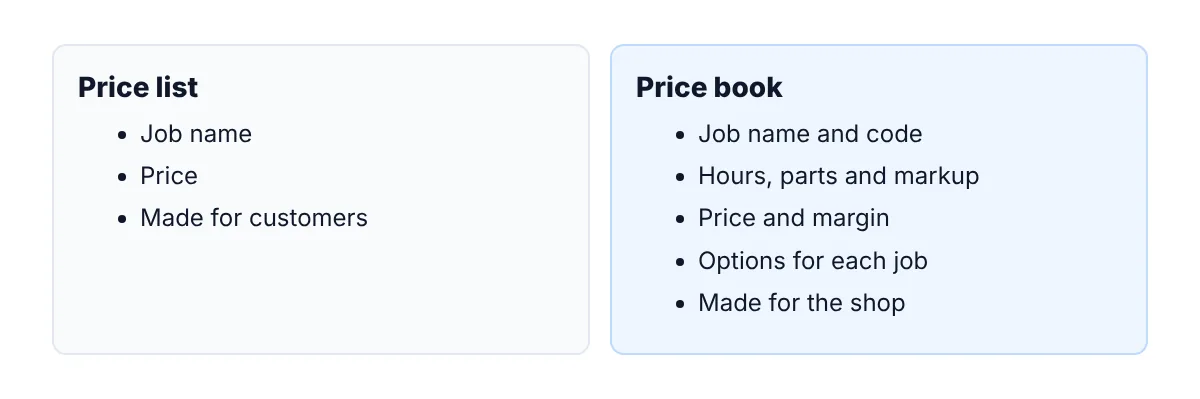
A price list shows job names and prices, and it’s made for customers. A price book also holds the hours, parts, markup and margin behind each price, and it’s made for the shop. You can print a price list from a price book, but a price list alone won’t tell you what to change when costs rise.
Sources
- Ace Hardware Home Services, how long to install a toilet, 28 Nov 2023
- Bob Vila, toilet installation cost, 22 Feb 2023
- Aptora Flat Rate Plus subscriptions, seen 3 Nov 2026
- Aptora Flat Rate Plus pricing, modified 6 Oct 2026
- Plumber Magazine, Mastering margins in the plumbing trade, 2 Jan 2025
- Profit Rhino SmartPrice pricing, seen 3 Nov 2026
- Profit Rhino homepage, seen 3 Nov 2026
- The New Flat Rate homepage, seen 3 Nov 2026
- LeadDuo plumbing price book builder, seen 3 Nov 2026
- Plumber Magazine, Is flat rate pricing the silver bullet, 15 Jul 2019
- Plumber Magazine, Confessions of a flat rate pricing convert, 2 Jul 2018
- ServiceTitan Community, Pricebook Pro thread, May 2022