
Junk fee laws for plumbers: all-in pricing rules by state in 2026
Junk fee laws for plumbers are state price-display laws. Our sources never apply them to plumbing, though several cover services broadly. Seven states in our sources set rules for mandatory fees alongside an advertised price. The FTC fee rule doesn’t cover home services. Applying any of this to a service call fee is our reading.
This page is general information, not legal advice. We aren’t lawyers. The state summaries below come from attorney general documents and law firm overviews we read on 3 Nov 2026. Talk to a lawyer in your state before you change how you advertise.
What the FTC junk fee rule covers
The FTC Rule on Unfair or Deceptive Fees covers live-event tickets and short-term lodging, not home services, according to Baker Hostetler’s year in review of 10 Dec 2025. A plumber’s service call falls outside that federal rule. For a plumbing shop, the question is at the state level, which is where Wiley’s overview of 13 Nov 2025 describes an expanding patchwork.
State-by-state table of all-in price laws
The seven state rules in our sources took effect between 1 Jul 2024 and 1 Jul 2026, and they don’t all say the same thing. This table is general information, not legal advice. It isn’t a list of every state, and laws change.
| State | Effective | What it says | Source |
|---|---|---|---|
| California | 1 Jul 2024 | Civil Code 1770(a)(29), SB 478. Covers most goods and services for personal use. “the advertised price must be the entire amount the consumer will have to pay.” Government taxes or fees and reasonable shipping for physical goods may be left out. Optional add-ons need not be included. Mandatory charges that cover costs like rent or salaries must be in the listed price. | California AG FAQ |
| Minnesota | 1 Jan 2025 | Applies to anyone who “advertises, displays, or offers a price for goods or services in Minnesota.” Price must be “the full price that the consumer is required to pay.” Disclosing a mandatory fee separately doesn’t satisfy the law. A breakdown may be shown in addition to the total. | Minnesota AG FAQ |
| Virginia | 1 Jul 2025 | Va. Code 59.1-607 et seq. The total price including mandatory fees must be clearly and conspicuously disclosed whenever a price is advertised. The advertised price itself need not be the total. Taxes, government fees and reasonable postage or shipping may be left out. | Baker Hostetler |
| Massachusetts | 2 Sep 2025 | 940 CMR 38.00. Total price must include fees consumers can’t reasonably avoid, other than government and shipping charges. Fees that depend on a choice the consumer hasn’t made wait until the choice is made, then the total must update. | Massachusetts AG guidance |
| Colorado | 1 Jan 2026 | HB25-1090. If a price is advertised, the total price must be included and be more prominent than other pricing. Government and shipping charges are left out. Variable fees may be left out if disclosed. | Baker Hostetler |
| Oregon | 1 Jan 2026 | SB 430. Online sales prices must include all fees the consumer must pay. Taxes, government fees and reasonable shipping or service-delivery charges may be left out. | Baker Hostetler |
| Connecticut | 1 Jul 2026 | SB 3. Advertised price must include all mandatory fees. Taxes, mandatory government fees and mandatory gratuities may be left out with disclosure. | Baker Hostetler, Regulatory Oversight |
Minnesota also lets a business leave out government taxes on the sale, reasonable shipping, reasonably avoidable fees such as late fees, and optional card surcharges. Penalties there run up to $25,000 per violation, according to Wiley.
For Virginia, Colorado, Oregon and Connecticut we relied on law firm summaries, not the statute text. A lawyer should read the statute for your state.
Where the state rules differ
The state rules differ on whether the advertised number itself must be the total, and those differences change what a plumbing shop’s price display has to look like. This is general information, not legal advice.
- California, Minnesota and Connecticut: the advertised price itself carries the mandatory fees.
- Massachusetts: the total must include fees the consumer can’t reasonably avoid, and a fee that depends on a choice can wait until the choice is made.
- Virginia: the advertised price doesn’t have to be the total. The total, with mandatory fees, must be clearly and conspicuously disclosed whenever a price is advertised.
- Colorado: the total must be included and be more prominent than other pricing.
- Oregon: our source summary covers online sales prices. It also lets reasonable service-delivery charges sit outside the price. Whether a plumber’s trip charge counts as one is a question our sources don’t answer, so ask a lawyer.
A display built for one state can fall short in another. If your trucks cross a state line, check each state you advertise in. Minnesota’s wording reaches anyone offering a price for services in Minnesota, which on our reading could include a shop based next door.
How a service call fee fits under these laws
None of these sources gives a plumbing example, so applying them to a service call fee is our reading, not a legal opinion. On that reading, a fee the customer must pay to get the job done looks like a mandatory fee, and in the stricter states it belongs inside the advertised price.
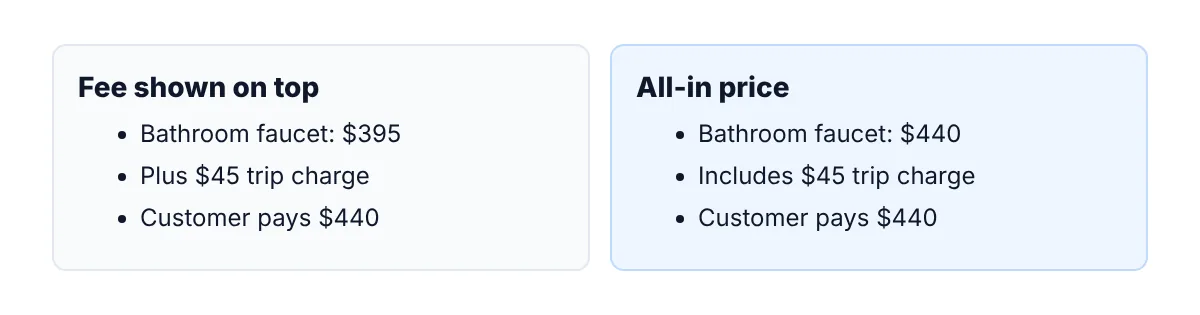
Here’s our illustration, modeled on Minnesota’s rule that a separately disclosed mandatory fee doesn’t satisfy the law. It uses the example shop’s bathroom faucet, made-up numbers:
- Labor: 1.5 hours x $136 = $204
- Parts: $120 at 60% markup = $192
- Labor plus parts: $204 + $192 = $396, rounded to $395 if shown alone
- Trip charge: $45
- All-in: $204 + $192 + $45 = $441, rounded to $440
Look at it from the customer’s side. “$395 plus $45 trip charge” means they pay $440 but see $395 first. “$440, includes $45 trip charge” is the same money, with the total first. On our reading, that second display fits the Minnesota FAQ’s statement that a breakdown may be shown in addition to the total.
To set the fee itself, use the plumbing service call fee guide. The flat rate price calculator builds the trip charge into one number.
What to change on your website, ads and price lists
The practical fix for a plumbing shop is to make the first number a customer sees the number they’ll pay, then show any breakdown beside it. These steps are our suggestions, not legal requirements. Run them past your lawyer.
Website
Start by listing every page that shows a price, including a “from” price, a coupon and a service area page. Show the all-in total first. If a page shows a price that excludes a mandatory fee, change the price or take it down until you’ve had advice.
Ads
Match every ad to the website, and don’t forget the truck. Paid search ads, mailers, truck wraps and social posts can all show a price. Oregon’s summary mentions online sales prices, so ask your lawyer how printed ads are treated there. Don’t assume.
Price lists
Build the trip charge into printed menus and any public price list, so techs and customers see the same number. Don’t keep a second sheet with lower prices for advertising.
Service call fee
If every customer pays the fee, on our reading it’s mandatory. Roll it into the job price, or advertise the visit itself at its full price. If a customer pays a service call fee and then approves a flat price that already contains the trip charge, don’t charge for the same trip twice. In the example, the customer owes $440 in total, not $485.
Diagnosis, then price
Some work can’t be priced until someone looks at it. State the price of the diagnosis visit up front as a total. After diagnosis, give one all-in price for the work before starting. Massachusetts guidance on choice-dependent fees, where the total must update once the choice is made, is a useful model, though it’s our reading that it applies here. See how to explain a flat price to customers for the conversation.
Taxes
Every state summary in our table allows government taxes to sit outside the advertised price in some form. Connecticut’s summary attaches a disclosure, so say “plus sales tax where it applies” wherever you show a price. Whether labor or parts are taxed in your state is a separate question for your accountant.
What to ask a lawyer in your state
A lawyer in your state should get specific questions, since the general rules above don’t answer how they apply to your exact fees.
- Do our service call fee, trip charge and after-hours charge count as mandatory fees?
- Can we advertise a diagnosis fee on its own, and what must it say?
- Do the rules cover printed ads, truck wraps and phone quotes, or only online prices?
- Which states’ rules apply if we work or advertise across a state line?
- Are our coupons and “from” prices allowed?
FlatPriced is being built with all-in prices by default. That’s a display setting. It doesn’t show that your shop meets any state’s law, and no software can settle that for you. Follow the flat rate pricing guide for the basics of the model, and put material changes through your price book so the totals you advertise stay right. A dated plumbing estimate template gives the customer the total in writing.
FAQs
Do junk fee laws apply to plumbers?
Junk fee laws don’t name plumbers in the sources we read, but several cover services broadly. California covers most goods and services for personal use, and Minnesota covers anyone offering a price for services there. Applying them to a plumbing shop is our reading, not a legal opinion, so confirm it with a lawyer in your state.
Does the FTC junk fee rule cover plumbers?
No. The FTC Rule on Unfair or Deceptive Fees covers live-event tickets and short-term lodging, not home services, according to Baker Hostetler’s review of 10 Dec 2025. State laws are a separate matter, and seven states in our sources have their own rules. This is general information, not legal advice, and rules can change.
Can a plumber still charge a service call fee?
None of the sources we read bans service call fees or gives a plumbing example. Their focus is on how a mandatory fee is shown next to a price. On our reading, the cautious display puts the fee inside the total. Minnesota’s FAQ says disclosing a mandatory fee separately doesn’t satisfy its law, though a breakdown may appear in addition to the total. A lawyer in your state can say if your fee counts as mandatory.
Do advertised plumbing prices have to include sales tax?
Generally no, according to the summaries we read. California, Minnesota, Massachusetts, Virginia, Colorado, Oregon and Connecticut each let government taxes or charges sit outside the advertised price in some form, and Connecticut’s summary says with disclosure. The exact wording differs, so check your state’s rule with a lawyer and add a short tax note beside your prices.
Does Virginia require the advertised price to be the total?
No. The Baker Hostetler summary says Virginia doesn’t require the advertised price to be the total price. It does require the total, including mandatory fees, to be clearly and conspicuously disclosed whenever a price is advertised. That differs from California and Minnesota. This is general information, not legal advice, so have a Virginia lawyer read Va. Code 59.1-607 for your shop.
Can I show a breakdown of my price?
Yes, in the sources we read, as long as the total comes with it. Minnesota’s attorney general says a breakdown may be shown in addition to the total, and California lets businesses itemize how a charge is used. The risk is showing the parts in place of the total. Have a lawyer confirm how this works in your state.
Sources
- California AG, SB 478 FAQ, read 3 Nov 2026
- Minnesota AG, Price Transparency Law FAQ, read 3 Nov 2026
- Massachusetts AG, guidance on unfair and deceptive fees, read 3 Nov 2026
- Baker Hostetler, 2025 year in review: junk fee laws, 10 Dec 2025
- Wiley, Expanding patchwork of state junk fees laws, 13 Nov 2025
- Regulatory Oversight, State attorneys general and continued enforcement against junk fees in 2026, April 2026