
How to start a plumbing business in 2026: license, costs and first prices
To start a plumbing business, confirm the license rules with your state board, choose an entity, get a free EIN from the IRS, buy insurance, total your truck and tool costs, and set first prices from your own numbers. We found no independent start-up cost survey, and vendor estimates run from about $5,000 to over $50,000.
Going out on your own is a big step, so take it one piece at a time, in this order.

Plumbing license rules vary by state
Plumbing license rules are set by states and sometimes cities, so call your state board before you spend money on anything else. The Bureau of Labor Statistics says most states and some localities require plumbers to be licensed. It also says pipefitters and steamfitters may need a special license for gas lines.
Three states show how far the rules can differ. These are examples only, and they’re general information and not legal advice.
| State | What the state source says | Date |
|---|---|---|
| Texas | A Responsible Master Plumber must hold a Texas Master Plumber license and carry at least $300,000 of general commercial liability insurance. That person answers for work done under the license and can be of record for one company at a time | Undated, seen 3 Nov 2026 |
| California | Contractors need at least four years of experience in the class they apply for and a $25,000 bond. A license is generally needed if a project requires a permit, uses other workers or totals $1,000 or more | Undated, seen 3 Nov 2026 |
| Pennsylvania | No state license for most construction contractors, but some of its 2,562 municipalities set their own plumbing rules. Home improvement registration with the Attorney General names master plumbers working on private homes | Registration page modified 25 Jun 2026 |
Ask your state board these questions, and call the city too:
- Which license do I need to offer plumbing work to the public and pull permits?
- Does the company need its own license, or a named license holder?
- Is a bond or a set amount of liability insurance required?
- Is gas work licensed separately?
- Does the city or county add its own license or registration?
- If I change my entity later, does the license carry over?
Choose a business entity before you file anything
A plumbing business can run as a sole proprietorship, an LLC or a corporation, and the choice affects your personal liability and your tax return. The IRS lists five structures, adding partnerships and S corporations, and says the structure decides which income tax return you file.
| Structure | How it starts | Personal liability, per the SBA |
|---|---|---|
| Sole proprietorship | Automatic if you do business without registering as something else | You can be personally liable for business debts |
| LLC | Registered with the state | Protects you from personal liability in most instances |
| Corporation | Registered with the state, and costs more to form | Strongest protection for owners |
Those liability notes come from the Small Business Administration (updated 7 Mar 2025). You’ll be working on other people’s property, and that carries real risk, so talk to an accountant or lawyer about your own case. Ask your state board first, too, because the license may need to match the entity. California, for one, issues licenses to individuals, partnerships, corporations, joint ventures and LLCs.
Get your EIN for free and separate your money
An employer identification number (EIN) is free from the IRS, and you should never pay a website for one. The IRS says you generally need one to hire employees or run a partnership or corporation, and that corporations and LLCs should form with their state before applying. Its list of who needs an EIN doesn’t name sole proprietors with no employees, so check with your bank.
Then open a business bank account, which the SBA’s launch guide calls a step once you’re ready to accept or spend money. Plan for taxes from the first invoice. The self-employment tax rate is 15.3%, and the tax applies once net earnings reach $400. Sole proprietors generally make estimated payments if they expect to owe $1,000 or more, across four payment periods a year.
Plumbing business insurance to price before your first job
A new plumbing business should price general liability, business auto and, once it has employees, workers’ compensation before taking a first job. Your state board’s minimum may set a floor: Texas asks a Responsible Master Plumber for $300,000 of liability coverage, and Pennsylvania’s registration asks for $50,000 personal injury and $50,000 property damage.
| Cover | What it’s for | Source |
|---|---|---|
| General liability | Bodily injury, property damage, medical expenses and defending lawsuits | SBA, updated 8 Apr 2024 |
| Workers’ compensation, unemployment, disability | The SBA says businesses with employees must have these, and that some states add more | Same |
| Business auto | A businessowners policy has no vehicle cover, so the truck needs its own policy | Triple-I, undated, seen 3 Nov 2026 |
Tell your agent exactly what you do, including gas work, water heaters and any work inside walls, so nothing comes as a surprise when you need the policy. The SBA suggests comparing several agents and reviewing coverage every year. Triple-I says many insurers recommend a $1 million auto liability limit, with $500,000 as a minimum.
How much does it cost to start a plumbing business?
We found no independent survey of what it costs to start a plumbing business. The figures in print come from software and service vendors, run from about $5,000 to over $50,000, and show no data behind them. Treat them as rough opinions.
| Source (vendor) | Total | Vehicle | Tools | Date |
|---|---|---|---|---|
| Housecall Pro | $10,000 to over $50,000 | $10,000 to $50,000 | $5,000 to $15,000 for equipment and supplies | 8 Jan 2026 |
| ZenBusiness | About $10,000 to $50,000 | $10,000 to $50,000 | $1,000 to $5,000 | 7 Jul 2026 |
| Workyard | $5,000 to $25,000+ | Used, $5,000 to $10,000+ | $1,000 to $2,000+ for basics | Undated |
Two things to watch. ServiceTitan’s $10,000 to $50,000 links to ZenBusiness, so repeats of that range aren’t separate estimates. And Housecall Pro’s own line items add up to $18,580 to $77,420 by our math, so its low end sits well above the $10,000 headline. The truck moves the total more than anything else, so a used truck or your own paid-off truck changes the picture.
Plumbing business start up costs to total
Total your own start-up costs from real quotes. The SBA blog’s method (6 Jan 2017) uses three buckets: pre-start expenses, assets such as vehicles and inventory, and cash in the bank to cover early losses.
| Cost | Type | Where to get the real number |
|---|---|---|
| Entity filing and registration | One-time, sometimes yearly | Your secretary of state |
| EIN | $0 | IRS |
| License, exam, bond | One-time plus renewals | Your state board and city |
| General liability and business auto | Ongoing | Two or three agents |
| Workers’ compensation | Ongoing once you hire | Your agent or state |
| Truck, shelving, lettering | One-time or monthly payment | Dealer and sign shop |
| Tools: drain machine, press tool, locator, hand tools | One-time | Supply house and your own kit |
| Truck stock | One-time, then restock | Supply house |
| Phone, website, first ads | One-time plus monthly | Your own quotes |
| Software | Monthly | Vendor pricing pages |
| Living costs and running costs while work builds | Monthly | Your own bank statements |
Worked example: adding up one start-up
This example uses made-up numbers for a solo plumber buying a used truck with financing. None of them is a market rate.
Start with the one-time costs:
- Entity filing $300, EIN $0, license and exam $400: $700
- Truck down payment $8,000, shelving and lettering $2,000: $10,000
- Tools $6,000, truck stock $3,000: $9,000
- Phone, website and first ads: $1,500
- One-time total: $700 + $10,000 + $9,000 + $1,500 = $21,200
Then the monthly costs:
- Insurance $400, truck payment $350, fuel $400, software and phone $150, ads $200: $1,500
- Owner’s living costs: $4,000
- Monthly total: $1,500 + $4,000 = $5,500
Now put the two together. Cash to line up, holding three months of costs: $21,200 + (3 x $5,500) = $21,200 + $16,500 = $37,700.
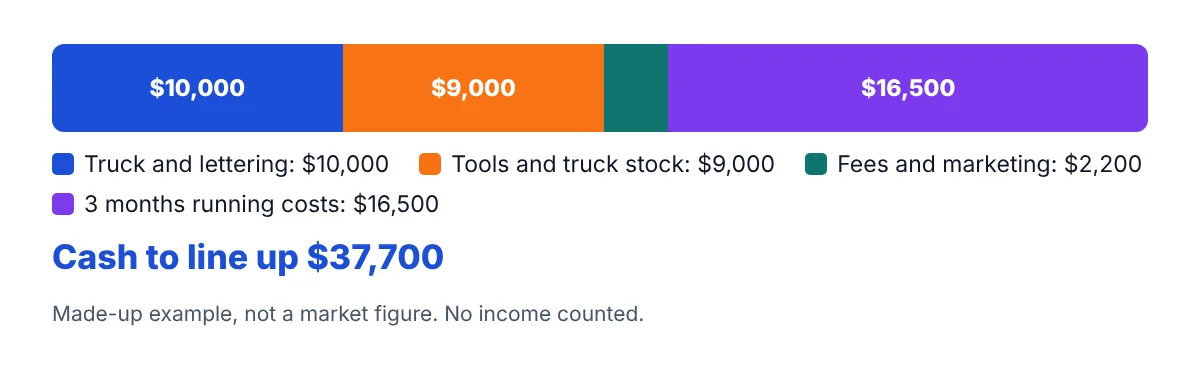
Three months is our choice for the example, and it counts no income at all. Pick the cushion that fits how much work you already have lined up. A plumber with a list of past customers may need less than one starting cold.
How to set your first prices
Your first prices should come from your own costs, because a rate copied from a competitor carries their overhead and their truck count. Here’s the whole idea: a flat price is hours times your rate, plus marked-up parts, plus a trip charge. Take a toilet fill valve in the example shop (made-up numbers): (0.75 x $136) + ($18 x 2) + $45 = $183, rounded to $185, and the flat rate price calculator runs the same math.
- Labor rate. Start from your paid hours, the share you can bill and your overhead including your own pay. The plumber labor rate calculator works it through.
- Price list. Begin with the small set of jobs you expect most and add others as they come. The price book build steps cover timing jobs and testing prices, and the free price book template has 40 jobs to edit.
- Service fee. Decide whether showing up is a separate fee or sits inside each price. The service call fee guide shows how to set it.
Put every price in writing with the plumbing estimate template, including what the price covers and how long it’s good for. FlatPriced is being built to quote from a phone, but it’s in pre-launch and isn’t available yet. The founding list is open if you want to hear when it launches.
First-year checklist for a new plumbing business
A first-year plumbing business checklist runs in four stages: before the first job, the first 90 days, before the first hire, and the first year-end. These are our suggestions, so adjust them to your state.
Before the first job
- License confirmed in writing with the state board and city
- Entity filed, EIN issued, bank account open
- General liability and business auto in force
- Truck stocked, tools insured or listed on a policy
- Written quote form and first prices ready
First 90 days
- Keep every receipt and invoice in one place
- Time your jobs and compare them with your price hours
- Set aside money for self-employment tax and make estimated payments on time
- Pull permits where the job calls for them
- Note license, bond and policy renewal dates
Before the first hire
- Get workers’ compensation and any state-required coverage in place
- Ask your accountant to set up payroll and payroll tax
- Add the new wage and payroll taxes to your labor rate
- Confirm who may do what under your license
First year-end
- Review your insurance, as the SBA suggests doing yearly
- Compare real hours and parts costs with your price list
- Update your prices
- Check your entity choice again with your accountant
FAQs
How much money do I need to start a plumbing business?
We found no independent survey, so we can’t give you a verified number. Vendor estimates run from about $5,000 (Workyard) to over $50,000 (Housecall Pro), with no data shown. Total your truck, tools, truck stock, license, insurance and a few months of running costs. Our made-up example comes to $37,700, which shows the method and isn’t a market figure.
Can I start a plumbing business without a license?
The answer depends on your state and city. The Bureau of Labor Statistics says most states and some localities require plumbers to be licensed. Pennsylvania has no state license for most contractors, yet some of its municipalities license plumbing work. Call your state board and the city where you’ll work, and get the answer in writing before you advertise.
Should a plumbing business be an LLC or a sole proprietorship?
The Small Business Administration says a sole proprietor can be personally liable for business debts, while an LLC protects owners from personal liability in most instances. The IRS says your structure decides which income tax return you file. Talk to an accountant or lawyer before filing, and ask your state board how the choice affects your license.
Do I need an EIN for a plumbing business?
You generally need an EIN to hire employees or run a partnership or corporation, according to the IRS. It’s free, and the IRS warns against sites that charge for one. Its list of who needs an EIN doesn’t name sole proprietors with no employees, so check with your bank. If you’re forming an LLC or corporation, file with your state first.
What insurance does a plumbing business need?
Price general liability and business auto first, then workers’ compensation before hiring. The Small Business Administration says businesses with employees must have workers’ compensation, unemployment and disability insurance, and states can add more. Some license rules also set a minimum, such as $300,000 of liability coverage for a Texas Responsible Master Plumber. Confirm yours with your board and an agent.
Can I use my personal truck for plumbing work?
Check with your insurer before you do. The Insurance Information Institute (Triple-I) says a personal auto policy covers some business use, but a vehicle used mainly for business likely has no coverage under it, and a business-owned vehicle isn’t covered at all. A businessowners policy has no vehicle coverage either, so plan on a business auto policy.
Sources
- Plumbers, pipefitters and steamfitters, Bureau of Labor Statistics, modified 29 Oct 2026
- Responsible Master Plumber, Texas State Board of Plumbing Examiners, undated, seen 3 Nov 2026
- Qualifying experience and Before applying, California Contractors State License Board, undated, seen 3 Nov 2026
- Contractor licensing, Pennsylvania Department of Labor and Industry, undated, seen 3 Nov 2026
- Home improvement contractor FAQ, Pennsylvania Attorney General, modified 25 Jun 2026
- Choose a business structure, updated 7 Mar 2025, Get business insurance, updated 8 Apr 2024, and Launch your business, undated, Small Business Administration
- How to estimate starting costs, SBA blog, 6 Jan 2017
- Business structures, reviewed 3 Oct 2026, Get an EIN, reviewed 16 Oct 2026, and Employer identification number, reviewed 17 Jul 2026, IRS
- Self-employment tax, reviewed 30 Oct 2026, and Estimated taxes, reviewed 25 Sep 2026, IRS
- Business vehicle insurance, Insurance Information Institute, undated, seen 3 Nov 2026
- How to start a plumbing business, Housecall Pro, 8 Jan 2026, vendor estimate
- Plumbing business startup costs, ZenBusiness, 7 Jul 2026, vendor estimate
- How to start a plumbing business, Workyard, undated, vendor estimate
- How to start a plumbing business, ServiceTitan, 16 Jul 2024, vendor estimate