
How to price multiple plumbing jobs on one visit in 2026
To price multiple plumbing jobs on one visit, charge the largest job at full price, then price each extra job as labor plus parts without a second trip charge. Take off any setup time the jobs share. In our example shop, a $185 fill valve drops to $105 when added to a $440 faucet job.
Why a second job on the same visit costs less to do
A second job on the same visit costs the shop less because the truck, the tech and the setup are already there. A flat price has a trip charge in it. So if you just add two book prices together, you charge the customer for two trips when only one happened.
That leaves a real pricing gap. Forum posters run into it too: one UK thread on r/askaplumberUK, “Cost for multiple little jobs”, asked how to price several small jobs on one visit, and the suggestion there was hourly. Anja Smith made the point for flat rate shops in Plumber Magazine on 2 Jul 2018, telling owners to look for a price book that can do add-on pricing.
How to price multiple plumbing jobs on one visit
Add-on pricing means a job has two prices in the book: a full price when it’s the reason for the visit, and a lower price when it’s added to a visit already under way. Four steps get you there. It’s an example method, and your numbers will differ.
Step 1: Price the largest job in full
The largest job carries the trip charge and all of its setup time, so its price doesn’t change. If the homeowner brings up the bigger job second, reorder the ticket.
Step 2: Drop the trip charge from every other job
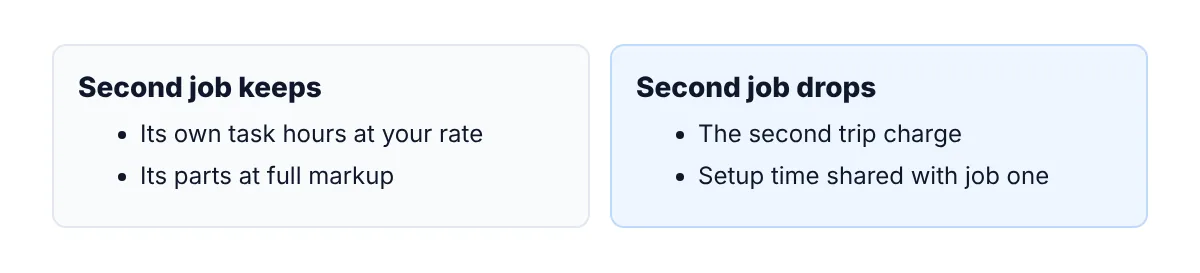
Take the trip charge off each extra job. The truck’s already in the driveway, so the shop doesn’t spend that money again.
Step 3: Take off shared setup time
Reduce the hours only where the jobs share real work. Two jobs in one bathroom might share a water shutoff, a drop cloth and a tool setup. A kitchen disposal and a hose bibb share almost nothing.
Step 4: Check the floor
Add up break-even labor and parts cost for the add-on, and make sure the add-on price clears it. The parts markup stays in place.
Worked example: a faucet and a fill valve on one visit
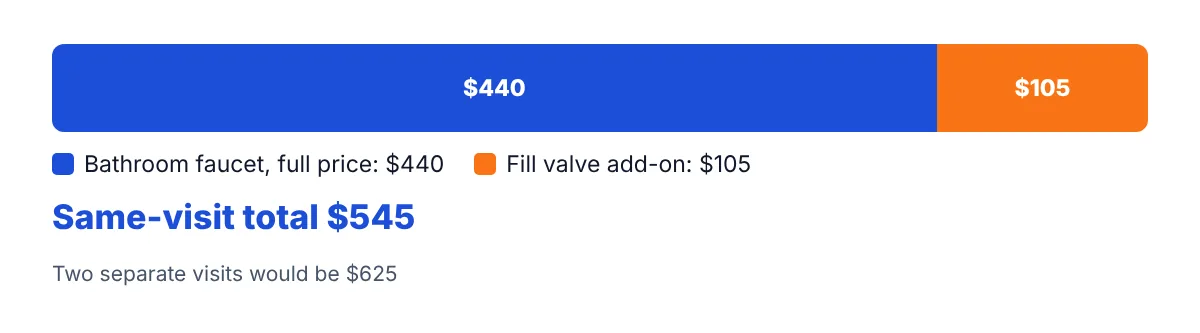
The example shop quotes $545 for both jobs on one visit, against $625 for two separate visits. All figures use the example shop’s made-up numbers: $136 an hour, $115.82 break-even, a $45 trip charge and rounding to the nearest $5. The 0.25 hours of shared setup is an example assumption, so measure your own.
Say the customer needs a bathroom faucet and a toilet fill valve replaced, both in the same bathroom.
| Line | Bathroom faucet, full price | Fill valve, full price | Fill valve, add-on |
|---|---|---|---|
| Hours | 1.5 | 0.75 | 0.75 – 0.25 = 0.5 |
| Labor at $136 | $204 | $102 | $68 |
| Parts sell price | $192 | $36 | $36 |
| Trip charge | $45 | $45 | $0 |
| Raw total | $441 | $183 | $104 |
| Flat price | $440 | $185 | $105 |
Now do the math for the visit:
- Two separate book prices: $440 + $185 = $625
- Same-visit price: $440 + $105 = $545
- Customer pays $80 less
Here’s where it goes. Of that $80, $45 is the dropped trip charge. $34 is the shared setup time (0.25 x $136). The other $1 is rounding. And if you price the faucet as the add-on instead, you land on the same total here: (1.25 x $136) + $192 = $362, rounded to $360, and $360 + $185 = $545.
Floor check on the add-on
The add-on still earns money. Break-even labor is 0.5 x $115.82 = $57.91. Add $18 of parts and the cost is $75.91. At $105, the add-on leaves $29.09, a margin of 28%.
The whole visit also holds up. Labor cost is 2.0 hours x $115.82 = $231.64. Add $138 of parts and you’re at $369.64. At $545, the shop keeps $175.36, a margin of 32%.
The shop gets all of that from one trip, and the tech is free 0.25 hours sooner than the two book times suggest.
Jobs that share no setup, and stacking a third job
When two jobs share no setup, the only reduction is the trip charge. Take a garbage disposal and a fill valve. They’re in different rooms, so the fill valve keeps its full 0.75 hours. Its add-on price is $102 + $36 = $138, rounded to $140. The visit is $475 + $140 = $615, down from $660 for two book prices. That’s $45 less, the same as the trip charge.
A third job follows the same rule, and stacking doesn’t need a bigger discount. Add a single-fixture drain clearing to the faucet and fill valve visit: 1.0 hour x $136 = $136, no parts, no trip charge, rounded to $135.
| Job | Book price | Same-visit price |
|---|---|---|
| Bathroom faucet | $440 | $440 |
| Toilet fill valve | $185 | $105 |
| Drain clearing, single fixture | $180 | $135 |
| Visit total | $805 | $680 |
The customer pays $125 less. Count it up: two dropped trip charges are $90, the shared setup is $34, and rounding is $1. No line is discounted for any other reason, so you can explain every dollar if the homeowner asks.
When not to use an add-on price
An add-on price fits only when the second job really saves the shop money. These cases don’t.
- The tech has already left. A new trip means a new trip charge.
- The extra job needs a supply house run. The trip you saved gets spent. Price the run into the add-on.
- The list is many tiny jobs. Ten small items may run better on time and materials or a block of hours. The flat rate vs hourly comparison shows when that fits.
A minimum charge applies to the visit and not to each add-on line. Our service call and minimum charge guide covers how to set one.
How to build add-on prices into your book
Add-on prices are easiest to use when they sit next to the job in the price book, so a tech doesn’t do math at the door. Keep a second column for each common job with the trip charge removed. Then note which pairs share setup, such as two jobs in one bathroom.
For a quick answer today, use the flat rate price calculator: set the trip charge to $0 and enter the reduced hours. The rest of the formula is in the how to price plumbing jobs guide.
FlatPriced is planned to include an add-on price for a second job on the same visit. It’s in pre-launch, so this isn’t available yet, and the founding list is open. The example hours on this page are placeholders, and no working plumber has checked FlatPriced’s starter hours yet. Replace them with your own job history.
FAQs
How do you price multiple plumbing jobs on one visit?
Charge the largest job at full price, then price each extra job as its labor plus parts, with no second trip charge and less any setup time the jobs share. In our example shop, a $440 faucet and a $185 fill valve total $545 on one visit instead of $625, because the fill valve add-on drops to $105.
Should a plumber discount a second job on the same visit?
A plumber should take off only what the shop doesn’t spend twice, which is the trip charge and any shared setup time. Parts markup and task labor stay in the price. That keeps the reduction tied to real savings, so you can explain it to a customer. Check that the add-on still clears your break-even labor plus parts cost.
Do you charge a trip charge for each job?
No. One visit carries one trip charge, however many jobs get done. If your flat prices have the trip charge built in, adding two book prices charges the customer twice for the same trip. Remove the trip charge from every job except the largest. If the tech leaves and comes back on another day, that’s a new trip with a new charge.
What is add-on pricing in plumbing?
Add-on pricing is a second, lower price for a job done during a visit already under way. Anja Smith advised owners in Plumber Magazine in July 2018 to look for a price book with add-on pricing. The lower price removes the trip charge and shared setup time, so the customer gets a fair total and the shop still earns margin on the extra work.
How much setup time do two plumbing jobs share?
It depends on the jobs, and we found no published figure. Our example uses 0.25 hours for two jobs in one bathroom, and that number is an assumption. Time a few real combined visits and compare them with your single-job hours. Jobs in different rooms may share nothing, so in those cases take off the trip charge only.
Sources
- Confessions of a flat rate pricing convert, Anja Smith, Plumber Magazine, 2 Jul 2018
- r/askaplumberUK thread “Cost for multiple little jobs”, forum post about 2 years old, read from search snippets on 2 Nov 2026