
How often plumbers should update a price book in 2026
No published standard says how often to update a plumbing price book. Our suggestion: review parts costs quarterly, which matches the cycle Profit Rhino and Workiz describe, and reprice sooner when a supplier increase hits a line you sell often. Copper and PVC moved enough in 2025 and 2026 to justify that pace.
How often to review parts and labor in your price book
A quarterly parts review is our suggestion for most small plumbing shops, because a fixed date gets done and a vague plan doesn’t. No rule requires it, so the call is yours. We found no independent figure on how often plumbing shops update, or how often they should.
The closest thing to a benchmark comes from vendors. Profit Rhino advertises quarterly updates, and Workiz says its catalogs are typically updated on a quarterly basis. Forum posters are asking the same thing: an r/electricians thread titled “Pricebook price update frequency”, about a year old, has one poster whose book auto-updates from linked suppliers and others asking how often to do it. Take that as forum talk, read through Google snippets on 2 Nov 2026.
| Trigger | What to review | Our suggestion |
|---|---|---|
| Calendar | Your top-selling jobs and their parts | Every quarter |
| Supplier increase letter | Every job using that product line | Before the next quote |
| A new duty or trade notice | Copper, brass and imported lines | Check your next invoices, then decide |
| Labor change | Wages, burden, billable hours, overhead | Once a year, and after any raise |
When wages go up, update labor with the plumber labor rate calculator too, because a raise moves every price in the book.
What changed in copper and PVC in 2025 and 2026
Copper moved through a run of tariff actions from August 2025, and PVC and copper fittings saw manufacturer increases in 2026. This timeline lists what our sources confirm.
| Date | What happened | Source |
|---|---|---|
| 1 Aug 2025 | 50% Section 232 duty began on semi-finished copper and intensive derivative products, under Proclamation 10962. It applied to copper content at first and covered pipes, tubes and pipe fittings. Refined copper was excluded. | Federal Register, Thompson Coburn |
| Mar to Apr 2026 | PM Magazine’s April roundup listed Charlotte Pipe 10% on PVC and CPVC, IPEX 10% on select lines, NDL 5% on ACR and PAC copper fittings, and Merit Brass 6% to 12% on average. | PM Magazine |
| 6 Apr 2026 | Proclamation 11021 moved the duty to full customs value, with annexes at 50% and 25%. | Federal Register |
| 8 Jun 2026 | Proclamation 11032 changed a US-content threshold from 95% to 85% and left the 50% and 25% rates unchanged. | Federal Register |
| Jul 2026 | PM Magazine’s July roundup listed JB Industries 7.5% on brass and Moen 10% on commercial lines. | PM Magazine |
| Sep 2026 | PM Magazine’s September roundup had no copper, PVC or tariff entries. It did list Liberty Pumps at about 5% on average, Amtrol 3% to 7% and Jones Stephens 5% to 15%. | PM Magazine |
| 19 Oct 2026 | A refined copper duty remained undecided. | Peacock Tariff Consulting |
We don’t state a current duty rate for copper tube or fittings, because we couldn’t confirm which annex of Proclamation 11021 holds them. FedEx guidance from 13 Aug 2025 listed tariff headings 7411 (tubes and pipes) and 7412 (fittings) as covered at that time, but the 2026 annex placement isn’t something our sources show. If you need the current rate, ask your supply house or a customs broker.
Two more things for your calendar. A proposal of 6 Aug 2026 would add 14 more derivative products, none named as plumbing. Comments closed on 27 Aug 2026, and we didn’t find the final outcome. PM Magazine’s October listing says increases slowed and moved to heating and controls lines. We saw that in the listing only.
Now, your own invoices beat every line in this table. A duty on imports can’t tell you what your supply house is charging you this week.
What the price indexes show about plumbing materials
Producer price indexes show the direction of material costs, and the Bureau of Labor Statistics series for copper pipe and tube rose 11.8% in six months. The copper pipe and tube series went from 363.292 in October 2025 to 406.170 in April 2026, which is 42.878 points on a base of 363.292. That percentage is our arithmetic, and the series has gaps.
The plastics pipe and fittings series stood at 455.493 in September 2026. One reading only shows a level, so don’t go using it as a percentage. Producer indexes track what manufacturers charge, not your local price. Treat them like a warning light on the dash, then reprice from your invoices.
How to update prices when material costs rise
Updating prices when material costs rise is a change to the cost input, after which your markup and formula do the rest. Don’t go in and edit finished prices by hand.
- Pull recent supply house invoices. Start with the parts on your top-selling jobs.
- Update parts cost, not the flat price. Keep your labor, markup and trip charge as they are.
- Group by material. Copper fittings, PVC, brass and water heaters each move on their own.
- Preview the new prices. Look for any job that jumps past a round number you’re comfortable standing behind.
- Check margin at the new cost. Use the plumbing markup calculator if a tier looks off.
- Date the book and tell the techs. One tech quoting off last quarter’s sheet undoes all of it.
You can do all of this in a spreadsheet. The free plumbing price book template has a Reprice tab that previews new prices at a percentage you set, and you copy the new parts costs into the Price book tab to apply them. FlatPriced is planned to reprice by material, category or whole book, with preview, undo and history. It isn’t live yet, and the plumbing flat rate software page lists what’s planned. Don’t have a book yet? Start with the price book build steps.
Worked example: a 10% rise on a water heater
A 10% rise on an $850 water heater moves the example shop’s flat price from $1,645 to $1,760, a 7% rise, because labor and the trip charge don’t change. These are example shop, made-up numbers.
The example shop prices a 40-gallon gas water heater replacement at 3 hours x $136, plus parts at 40% markup, plus a $45 trip charge, rounded to the nearest $5.
| Line | Today | After a 10% parts rise |
|---|---|---|
| Parts cost | $850 | $850 x 1.10 = $935 |
| Parts sell at 40% markup | $850 x 1.40 = $1,190 | $935 x 1.40 = $1,309 |
| Labor, 3 hours x $136 | $408 | $408 |
| Trip charge | $45 | $45 |
| Raw total | $1,643 | $1,762 |
| Flat price, nearest $5 | $1,645 | $1,760 |
Do the math: the price goes up $115, and $115 / $1,645 is 7.0%.
Now say the heater goes up and you leave the price at $1,645. Direct cost is 3 hours x $115.82 = $347.46, plus parts at cost:
- Today: $1,645 – ($347.46 + $850) = $447.54 left, a 27% margin.
- Heater at $935, price not updated: $1,645 – ($347.46 + $935) = $362.54 left, a 22% margin.
- Heater at $935, repriced to $1,760: $1,760 – ($347.46 + $935) = $477.54 left, a 27% margin.
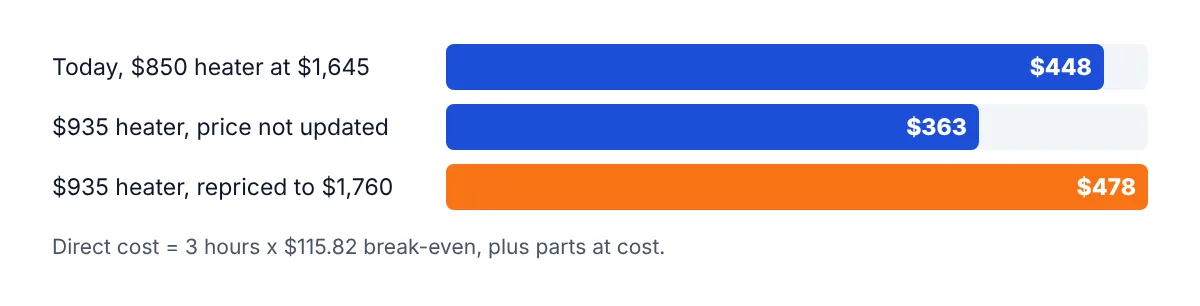
Skip the update and this shop gives up $85 on every install. The whole parts rise comes right out of margin. Reprice, and the percentage goes back to 27%, and you’re $30 a job ahead of today, since markup applies to the higher cost.
How to handle quote validity while prices move
A valid-until date on every quote is how a plumbing shop stops an old price from outliving its parts cost. Quote validity is a practice, and we found no reliable number for how long a plumbing quote should last. So set your own period, based on how often your supply house changes prices on that job. Water heaters and copper repipes may need a shorter window than a faucet.
Honor the date you wrote. Your word’s on that paper. Once the quote expires, reprice from the current book and tell the customer why. Our plumbing estimate template has a valid-until line.
How a material clause works in a plumbing quote
A material clause is a line in a quote that says what happens if a named material’s cost changes before the work is done. It’s most useful on large jobs with a long gap between approval and install, such as a repipe. On a same-day service call, just let the flat price stand.
Here’s sample wording, written by us as a suggestion, not legal text: “This price is based on material costs on the quote date. If the cost of [material] rises before work starts, we will show you the new price before we begin, and you may accept it or cancel.” Have a lawyer read any clause before you use it. If you advertise prices, see all-in pricing rules too.
FAQs
How often should a plumbing price book be updated?
No published standard exists, and we found no independent figure. Our suggestion is a parts review every quarter, an extra check whenever a supplier increase hits a product line you sell often, and a labor review once a year. Profit Rhino and Workiz both describe roughly quarterly catalog updates, which are vendor practices and not a rule.
Do copper tariffs affect my plumbing prices?
Copper duties can raise what you pay, but your own invoices show by how much. A 50% duty began on 1 Aug 2025 and the method changed on 6 Apr 2026. We couldn’t confirm the current rate on copper tube or fittings, so we don’t state one. Reprice from what your supply house actually charges you.
How much does a 10% parts increase raise a flat price?
A 10% parts increase raises a flat price by less than 10%, because labor and the trip charge don’t change. In our example shop, an $850 water heater going to $935 moves the flat price from $1,645 to $1,760, a 7% rise. Those are made-up numbers, so run your own job through the same formula.
Should I change prices on quotes I already sent?
If a quote has a valid-until date, honor it until that date. You gave your word, and that’s how you keep the customer’s trust. After expiry, reprice from the current book and explain why. Large jobs with a long wait before install can carry a material clause, which should be read by a lawyer before use.
What should a plumber do first when a supplier raises prices?
Find every job in the book that uses the affected product line, then update the parts cost on those jobs and let your formula set the new price. Don’t change finished prices by hand. Check the jobs you sell most before the rare ones, then date the book and tell your techs which prices moved.
Sources
- Proclamation 10962, Federal Register, 5 Aug 2025
- Thompson Coburn on the copper tariff proclamation, 23 Sep 2025
- FedEx guidance on Section 232 duty for copper, 13 Aug 2025
- Proclamation 11021, Federal Register, 9 Apr 2026
- Proclamation 11032, Federal Register, 4 Jun 2026
- Proposed copper derivative additions, Federal Register, 6 Aug 2026
- Copper limbo, Peacock Tariff Consulting, 19 Oct 2026
- PM Magazine, PHCP PVF price increases, April 2026, 2 Apr 2026
- PM Magazine, PHCP PVF price increases, July 2026, 8 Jul 2026
- PM Magazine, PHCP PVF price increases, September 2026, 4 Sep 2026
- PM Magazine, price increase listing, 6 Oct 2026
- Bureau of Labor Statistics PPI, copper pipe and tube, via FRED, April 2026 data
- Bureau of Labor Statistics PPI, plastics pipe and fittings, via FRED, September 2026 data
- Profit Rhino homepage, seen 3 Nov 2026
- Workiz Price Book Pro FAQ, undated