
Why do plumbers charge so much? How to explain your price
Plumbers charge what looks like a lot because a billable hour pays for far more than one hour of wages. Customers compare your price with a wage or a part. Your answer is to show them what’s inside it: unbilled hours, payroll burden, overhead and profit. This page gives you the numbers and the plain words to explain it.
Why customers ask why plumbers charge so much
Customers ask why plumbers charge so much because they can see a part and a short visit, and they can’t see the shop behind them. Nobody’s being unreasonable here. They’re doing fair math with the numbers they have.
The question is everywhere. An r/Plumbing thread titled “Why Do Plumbers Charge So Much?”, about a year old, drew over 260 comments, with plumbers explaining overhead. An r/mildlyinfuriating post about a $970 charge for a $14 part drew over 130. Those figures come from Google result snippets we read on 2 Nov 2026, so treat them as forum talk.
Plumbers feel this from their side too. A PlumbingZone poster compared a $575 flat-rate bill with a $295 time-and-materials estimate and worried that raising rates would feel like stealing. Anja Smith wrote in Plumber Magazine in 2018 that customers still come with a set idea of what a plumbing job is worth.
Don’t defend every price in the trade. Defend yours, with your numbers.
What’s inside a plumber’s price
A plumber’s price contains wages for every paid hour, payroll burden, overhead, the owner’s pay and profit, and the example shop needs $115.82 per billable hour just to break even. The Bureau of Labor Statistics puts the median pay for plumbers, pipefitters and steamfitters at $30.67 an hour (May 2025). Say a customer knows that number. They look at a billed rate and see a big gap. Here’s that gap, in our example shop, made-up numbers.
The shop has 3 techs at $32.00 an hour, close to that median, with 12% payroll burden, 2,080 paid hours each, 60% of them billable, and $210,000 a year of overhead including the owner’s pay. Target net margin is 15%.
| Piece of one billable hour | Arithmetic | Per billable hour |
|---|---|---|
| Wages, including unbilled hours | $32.00 / 0.60 | $53.33 |
| Payroll burden | $32.00 x 12% / 0.60 | $6.40 |
| Overhead and owner’s pay | $210,000 / 3,744 billable hours | $56.09 |
| Break-even | Sum of the above | $115.82 |
| Target profit | $136 – $115.82 | $20.18 |
| Billable rate | $115.82 / (1 – 0.15) = $136.26, used as $136 | $136.00 |
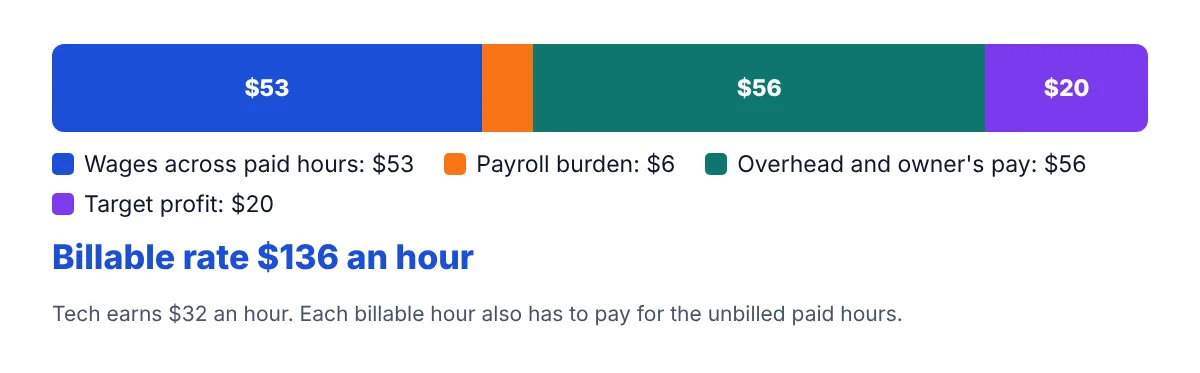
Three lines do most of the work. Start with unbilled time. The tech’s $32 costs $53.33 per hour sold, because you’re paying for drive time, supply house runs and estimates, and none of that gets billed. Overhead adds $56.09. Profit is $20.18 of the $136. So in this example, the wage on a billable hour is less than half the rate.
The $136 is one made-up shop’s rate. For what plumbers publish as market ranges, see the plumber hourly rate guide. To run this math on your own shop, use the free plumber labor rate calculator. The 15% is also an example. Vendors offer opinions on net margin, and no independent US plumbing figure turned up in our sources.
Worked example: the $185 fill valve with an $18 part
An $18 fill valve becomes a $185 flat price because the part is the smallest thing the customer is paying for. This is the example shop’s fill valve job, made-up numbers, at 0.75 hours.
| Line | Arithmetic | Amount |
|---|---|---|
| Labor | 0.75 hours x $136 | $102 |
| Part at 100% markup | $18 x 2 | $36 |
| Trip charge | Example shop’s built-in charge | $45 |
| Raw total | $102 + $36 + $45 | $183 |
| Flat price | Rounded to nearest $5 | $185 |
So the homeowner sees an $18 part and a $185 bill. After direct cost of $105 (0.75 x $115.82, plus the $18 part), the shop keeps $80 toward profit. Our example uses 0.75 hours as an input. We found no published pro time for a fill valve, so replace it with your own job history.
Scripts for explaining a price at the door
Scripts for explaining a price work best in short plain words, said once, with no apology. These are our suggestions, written for this page and not tested with customers. Change them until they sound like you.
“Why so much?”
“Fair question. That price covers the part, my time, the truck and everything it takes to get a licensed plumber to your door today. And it’s fixed, so it won’t go up if this takes me longer than I expect.”
Say “licensed” only if it’s true in your state and for you.
“The part is $18 at the hardware store”
“You’re right, it is. And if you’d like to put it in yourself, that’s a fair choice. My price is for the job done and backed by us, and the part is a small piece of that.”
“That only took 20 minutes”
“It did. You’re paying for the job, and the minutes don’t change it. If it had taken two hours, you’d have paid the same.”
Only say this if you really do honor it. A flat price has to hold on the bad days too. See the flat rate vs hourly comparison for when each method fits.
“Another plumber quoted less”
“That may be a good price. Just make sure both quotes cover the same work and parts. Here’s exactly what mine includes.”
Then stop. Don’t talk down the other plumber.
“Can you do it for less?”
“I can’t take money off the same job, but I can change the job. Here’s a lower-cost option that still fixes it.”
Knock money off and you teach customers that the first price wasn’t real. Change the scope and you don’t, which is why three real options help here.
How to handle a request for a price breakdown
The simplest way to handle a request for a price breakdown is to decide your shop’s answer in advance and give every customer the same one. Refusing outright looks bad. An r/askaplumber thread titled “Company quoting a flat price & refuses to provide a breakdown”, about six months old, drew over 70 comments, and that’s a thread you don’t want your name in. Forum talk again, from Google snippets.
You have three workable answers:
- Scope breakdown. List what’s included: parts replaced, shutoffs, haul-away, warranty terms. This answers most requests.
- Parts and labor split. Show labor, parts and trip as lines, using the same numbers as your book. The fill valve table above is that view.
- Your cost, on request. This one is a shop policy call. If your answer is no, say so straight and say why.
A sample answer, also our suggestion: “I price by the job, so the number doesn’t change. I’m happy to list what’s included, and I can show you how it splits between parts and labor.”
Anja Smith also pointed out in Plumber Magazine in 2019 that flat-rate invoices are less detailed, which hurts job costing. So a line-level record helps you as much as the customer. For how a breakdown fits beside a total on advertised prices, see all-in pricing and fee laws.
How to head off the question before the price comes up
Heading off the question means giving the price before work starts, with the reason already attached.
- Show the problem first. A photo of the failed part does more than a speech.
- Price before you pick up a wrench. An invoice surprise is the worst time to explain anything.
- Show prices online if you can. A 2024 ACHR News survey article reported that 70% of HVAC customers said they were more likely to call a price-transparent company, 29% said it made no difference, and 31% of HVAC contractors showed prices. Those figures are about HVAC, and we found no plumbing equivalent.
- Train the person who answers the phone. The first “how much?” often comes before a truck rolls.
If you can’t explain a price, check it. A price built from your own rate is one you can defend. Start with the flat rate pricing guide, then test a job in the flat rate price calculator.
You can also send homeowners our plain guide to reading a plumbing quote before the visit.
FAQs
Why do plumbers charge so much?
Plumbers charge more than their hourly wage because each billable hour also pays for unbilled time, payroll burden, trucks, insurance, office costs, the owner’s pay and profit. In our example shop, made-up numbers, a tech earning $32 an hour needs a $136 billable rate. The Bureau of Labor Statistics median wage was $30.67 in May 2025.
How do I explain a flat rate price to a customer?
Say what the price covers, say that it’s fixed, and stop. A short version: the price covers the part, the time, the truck and the work behind it, and it won’t change if the job runs long. Give the price before starting work, and show what you found first. This wording is our suggestion, so make it your own.
Why does a plumber charge so much for a small part?
The part is usually a small piece of the bill. In our example shop, made-up numbers, an $18 fill valve job comes to $185, with $102 of that being labor and $45 the trip charge. The part sells at $36 after markup. Most of the price pays for getting a plumber there and doing the work.
Do I have to give a customer a price breakdown?
The sources we read don’t set a general duty for plumbers to break down a flat price, and rules vary by state, so ask a lawyer about yours. As a practice, a scope list or a parts and labor split answers most requests. Minnesota’s attorney general says a breakdown may appear alongside a total.
Should I lower my price when a customer says it’s too much?
We’d suggest changing the scope, not the price. Offer a lower-cost option that still solves the problem, or show what could wait. Knock money off the same job and you tell the customer the first number wasn’t real. You also tell them to ask every time. If the price truly can’t be explained, recheck your book.
Should plumbers show prices on their website?
There’s no plumbing-specific data in our sources, so this is a judgment call. A 2024 ACHR News survey article found 70% of HVAC customers said they were more likely to call a price-transparent company, and 29% said it made no difference. If you show prices, show the total, and check the rules in your state with a lawyer.
Sources
- Bureau of Labor Statistics, Occupational Outlook Handbook: plumbers, pipefitters and steamfitters, modified 29 Oct 2026
- Anja Smith, Confessions of a flat rate pricing convert, Plumber Magazine, 2 Jul 2018
- Anja Smith, Is flat rate pricing the silver bullet you’re looking for, Plumber Magazine, 15 Jul 2019
- PlumbingZone, Flat Rate Price Book – HELP!!!, 2008
- ACHR News, HVAC customers and contractors at odds with online pricing, 10 Dec 2024, HVAC only
- Reddit threads on r/Plumbing, r/askaplumber and r/mildlyinfuriating named above: forum talk read through Google result snippets, 2 Nov 2026, no thread URLs in our notes