
How to read a plumbing quote: a plain guide for homeowners
To read a plumbing quote, find the total you’ll pay, then check what work and parts it covers, what could change it, and how long it stays good. Ask for it in writing before approving. A quote can’t prove a price is fair, but it lets you compare apples to apples.
How to read a plumbing quote: what it should show
A plumbing quote should show who is doing the work, exactly what they’ll do, the total, and what could change that total. A one-line number can be honest, but it’s hard to compare and easy to misremember. This is what we’d look for, and what a shop actually puts on paper varies.
| On the quote | What to look for |
|---|---|
| Who | Shop name, phone and address, plus a license number if your state licenses plumbers |
| The job | Specific wording, such as “replace 40-gallon gas water heater” and not just “water heater” |
| Parts | Brand, model or grade for anything big |
| Total | One number for everything listed, and whether tax is in it |
| Included | Haul-away, connectors, testing, permit if one is needed |
| Left out | Anything the shop is not pricing, such as patching a wall |
| Valid until | The date the price runs out |
| Warranty | Terms for parts and for labor |
| Payment | Any deposit, and when the rest is due |
For a sample layout, see this plumbing estimate template we made for shops.
What a flat price should include
A flat price should be the total for the job as described, with the parts, labor, trip and cleanup that job needs. You get one number, and it holds whether the job takes a little longer or a little less, as long as the job stays the same.
Before you say yes to that number, check that it covers:
- The small parts. On a toilet, that means the wax ring that seals it to the floor and the water line that feeds it. On a faucet, it means the hoses under the sink, if they need replacing.
- The trip. Ask if a service fee or trip charge, which is what some shops charge just to come out, gets added on top. Some shops build it in, and others list it separately. Published service call figures show how much that fee can be.
- Removal. Ask who takes away the old toilet, water heater or garbage disposal, and whether that costs extra.
- Testing and cleanup. Ask whether these are in the price. It takes a few seconds.
- Permits. Some work needs one, depending on where you live and what’s being done. Ask who gets it and whether the cost is in the price.
A flat price can’t cover what nobody has seen yet. If the plumber opens a wall and finds rot, or an old shutoff valve fails, that may be work the quote didn’t cover. Ask who pays for it. A fair way to handle it is for the plumber to stop, show you, and give a new total before going on.
Flat price or hourly quote, in plain words
A flat price is a fixed total agreed before work starts, so you know the number and the shop carries the risk if the job runs long. An hourly quote charges for the time used plus parts, so the final bill can land above or below the estimate, and our comparison of flat rate and hourly pricing shows when each one fits.
Questions to ask before you approve a plumbing quote
The most useful question before approving a plumbing quote is “Is this the total I’ll pay?” Don’t feel shy about any of these. They’re ordinary questions, so pick the ones that fit your job:
- Is this the total, including any trip charge, fee and tax?
- What exactly is included, and what isn’t?
- What could change this price, and will you stop and ask me first?
- Which part or model is this price for?
- Is there a lower-cost option that still fixes the problem?
- Does any of this need doing today, or can part of it wait?
- What’s the warranty on parts and on labor?
- Will this need a permit?
- How long is this quote good for?
- Do I owe anything if I say no?
You can also ask for a split between parts and labor. Some shops will give one, and some price by the job and won’t show their costs. Their reasons can be ordinary ones, and how plumbers explain a flat price gives the shop’s side. A list of what’s included is usually enough to compare quotes. We haven’t researched whether any state requires a breakdown, so ask your state’s consumer protection office if it matters.
How to compare plumbing quotes fairly
Comparing plumbing quotes fairly means comparing totals for the same work, the same parts and the same terms. Line them up side by side before you look at the price. Check that each one covers the same job, the same grade of part, the same extras and the same warranty.
Here’s a made-up example. These prices aren’t market rates, and they’re here only to show the math. Two shops quote the same toilet replacement.
| Line | Quote A | Quote B |
|---|---|---|
| Toilet replacement | $600 | $520 |
| Service fee | Included | $45 |
| Haul-away of the old toilet | Included | $60 |
| Total | $600 | $520 + $45 + $60 = $625 |
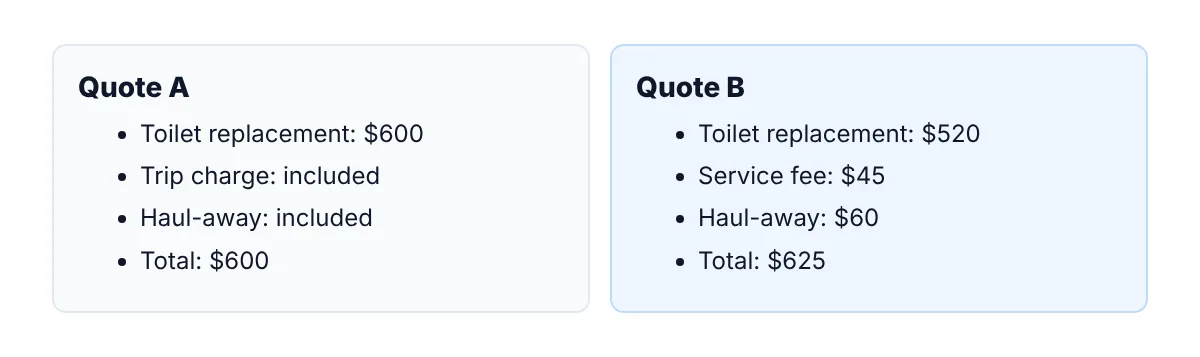
Quote B looks $80 cheaper at the top ($600 – $520) and costs $25 more at the bottom ($625 – $600). The example could easily go the other way. A shop with a higher total may be installing a better toilet or giving a longer warranty, and you’d only learn that by asking.
Hourly quotes take one more step. Ask how many hours the plumber expects and whether they’ll call you before going past that. Then work out a low and a high total to set beside any flat price.
Hourly rates vary a lot by market, and our plumber hourly rate guide lists published figures. Some shops charge for a quote and some don’t, so ask before the visit.
Emergency and weekend premiums on a plumbing quote
Emergency and weekend plumbing work usually costs more, and published premiums run from about 20% on the total to triple the normal rate. These figures come from national cost guides written for homeowners. They disagree with each other, and your local shop sets its own premium.
| Source | Published figure | Date |
|---|---|---|
| Angi, plumber cost | Emergency work at 1.5 to 3 times | Undated, figures “in 2026” |
| Angi, outdoor faucet cost | After-hours or weekend work adds 20% to 50% to the total | Undated, “2025 Data” |
| HomeAdvisor, hire a plumber | Evenings at time and a half, weekends double, holidays triple at some shops | Undated, seen 3 Nov 2026 |
To see what that can mean, take a made-up $600 regular-hours job. Angi’s 20% to 50% would make it $720 to $900 ($600 x 1.20 and $600 x 1.50). A shop may use a different method altogether, so ask for the actual after-hours total.
Shops set these premiums for their own reasons, and we can’t tell you whether one is fair. It’s still your money, so ask these two things before you book:
- What’s the whole price tonight, and what’s the whole price during regular hours?
- If I shut the water off, can this safely wait?
If water is running and you can’t stop it, waiting may cost more than the premium. If the water stays off and you have another bathroom, waiting for regular hours may be an easy call. The plumber can tell you more once they know the setup.
How to ask for the price in writing
The simplest way to get a price in writing is to ask for it by text or email before the work starts. You don’t need a formal request. Something like this works:
“Could you send me that price and what it includes before you start?”
If the job changes partway through, ask the same thing: “Could you send me the new total before you go on?” A quick text is enough for most small jobs. On bigger work, ask for a signed estimate.
Keep the quote, any photos and the invoice together, then compare the invoice with the quote when the job is done. A price given over the phone may change once the plumber sees the job, so treat it as a starting point until someone has looked.
We haven’t researched whether any state requires a written quote. Your state’s consumer protection office is a good place to ask. Several states also set rules on showing mandatory fees in an advertised price, and our guide to all-in pricing is general information on those rules, not legal advice.
What a plumbing quote can’t tell you
A plumbing quote can’t tell you whether a price is fair, and neither can we. We don’t know your home, your area or the shop. Cost guides publish ranges, and two honest shops can land far apart because their costs, warranties and schedules differ.
Forum talk shows both sides. On r/askaplumber, homeowners post asking whether they got ripped off, as in a thread called “How badly was I ripped off”, about nine months old. In another thread there, about two years old, a plumber defended flat rate while admitting that scammers exist. We read those through Google snippets on 2 Nov 2026, and they’re opinions.
So if a price surprises you, ask what’s included, ask what could wait, and get a second quote if the job allows the time. A high number alone doesn’t mean anyone is cheating you. A low one doesn’t mean the work is covered.
We’re building pricing software for plumbing shops, so read this page knowing that. Shop owners are welcome to share it with customers.
FAQs
Can I negotiate a flat price with a plumber?
You can ask. Some shops will change the job instead of the price. A shop that prices by the job may keep prices the same for every customer, so ask what a lower-cost option would look like, or whether part of the work can wait. Some shops do discount, and that’s their call. Shop policies vary, so there’s no single rule.
Should I get more than one plumbing quote?
If the job can wait and it’s a big one, a second quote is reasonable. A water heater, new pipes through the house or a sewer line gives you time and has real money at stake. With a burst pipe, waiting may cost you more than a second quote saves. Check first whether the shop charges for the visit, because some do and some don’t.
Can the price change after I approve it?
A flat price is meant to hold for the job you approved, even if it takes longer than planned, and your quote’s written terms come first. It can change if the work changes, such as hidden damage or a part that has failed and wasn’t in the quote. The plumber should stop, show you and give a new total before doing more. An hourly quote can move with the time used.
Do I have to pay if I say no to the quote?
Shop policies differ, and this isn’t legal advice. Some shops charge a service call fee or a fee to find the problem, and others include it only when a job goes ahead. Ask when you book, and ask whether the fee comes off the price if you approve the work. Published fee ranges are on our service call page.
How do I know if a plumbing quote is fair?
Nobody can confirm that from the page alone, including us. What you can check is whether the quote is clear: a total, a specific description of the work, named parts and stated terms. Then compare it with another quote for the same work. A clear quote that costs more may still be the better deal, and a low one may leave things out.
Is the cheapest plumbing quote the best one?
Sometimes it is, if it covers the same work, the same parts and the same warranty as the others. Check the total first, since a low price at the top can grow once fees and haul-away are added. If everything matches and you trust the shop, there’s nothing wrong with picking the lowest price. If something doesn’t match, ask about it before deciding.
Sources
- Plumber cost, Angi, undated, figures “in 2026”, seen 3 Nov 2026
- Cost to replace an outdoor faucet, Angi, undated, “2025 Data”
- Cost to hire a plumber, HomeAdvisor, undated, seen 3 Nov 2026
- r/askaplumber threads “How badly was I ripped off” (about 9 months old) and “A lot of you asking if you got ripped off need to hear…” (about 2 years old): forum talk read through Google result snippets, 2 Nov 2026, no thread URLs in our notes