
What is the 135 rule in plumbing? (With diagrams)
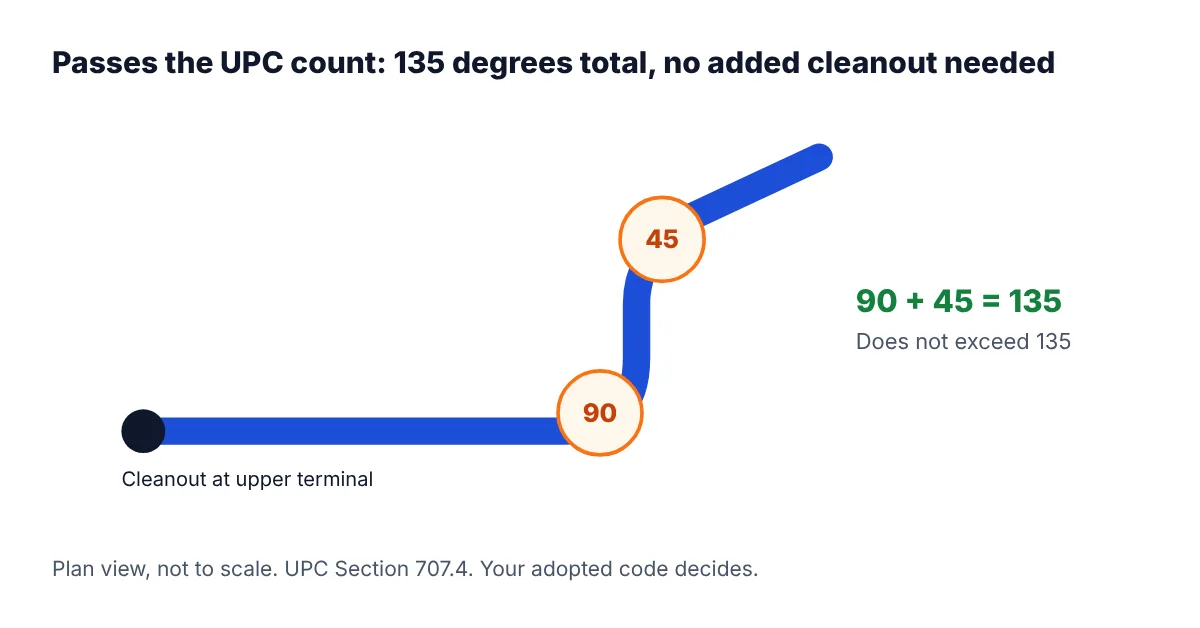
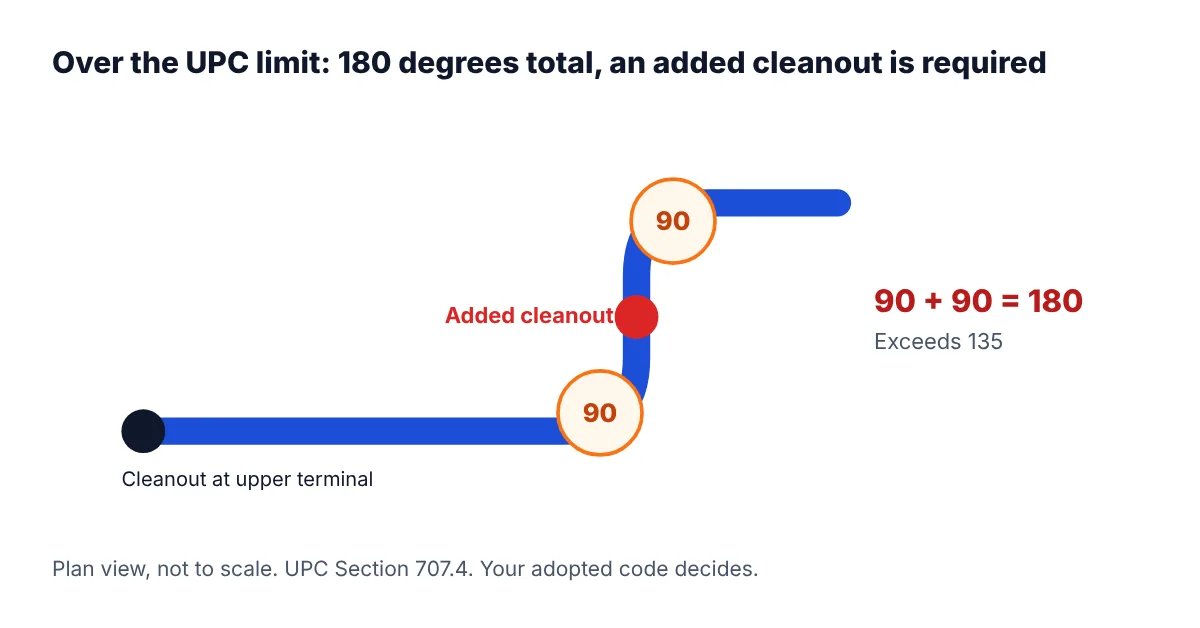
The 135 rule in plumbing is a Uniform Plumbing Code (UPC) cleanout rule that has nothing to do with pricing. A drain line needs an additional cleanout for each aggregate horizontal change in direction exceeding 135 degrees. One 90 plus one 45 equals 135 and passes. Any further bend needs a cleanout. Your local adopted code decides.
How to count to 135 degrees
Counting to 135 degrees means adding up every horizontal change in direction along the drain line. The limit is exceeded only when the total goes past 135, so exactly 135 passes.
One 90 plus one 45
One 90 plus one 45 equals 135 degrees. That doesn’t exceed 135, so UPC 707.4 calls for no additional cleanout. But add one more bend, any size, and you’re past 135, so now you need an added cleanout.
Three 45s
Three 45s also equal 135 degrees and pass. Throw in a fourth 45 and you’re at 180, and that needs an added cleanout.
Long sweep and short 90
A long sweep 90 and a short 90 both turn the line 90 degrees. The quoted code sentence counts change in direction and says nothing about fitting radius, so on our reading both count as 90. Which fittings are allowed where is a separate question for your adopted code.
Worked example: counting real layouts
This table adds up five layouts under the UPC sentence and the 45 degree wording in the IPC and IRC. It’s our count from the quoted sentences alone, without exceptions, and it doesn’t include the cleanout each horizontal drain needs at its upper terminal.
| Layout | Total degrees | Over 135? | Added cleanouts, UPC 707.4 | Bends over 45, IPC and IRC wording |
|---|---|---|---|---|
| 45 + 45 | 90 | No | 0 | 0 |
| 90 + 45 | 135 | No | 0 | 1 |
| 45 + 45 + 45 | 135 | No | 0 | 0 |
| 90 + 45 + 22.5 | 157.5 | Yes | 1 | 1 |
| 90 + 90 | 180 | Yes | 1 | 2 |
The quoted sentence doesn’t spell out where the count restarts on a long run with several turns. Ask the authority having jurisdiction before you assume. A phone call now beats digging it back up later.
What the Uniform Plumbing Code says about the 135 rule
The Uniform Plumbing Code states the 135 rule in Section 707.4 of the 2024 edition. As quoted by the International Association of Plumbing and Mechanical Officials (IAPMO) in its Uniform Code Spotlight of 30 May 2024:
“An additional cleanout shall be provided in a drainage line for each aggregate horizontal change in direction exceeding 135 degrees (2.36 rad).”
The same IAPMO piece lists the other parts of the section:
- Each horizontal drainage pipe needs a cleanout at its upper terminal.
- A run over 100 feet in total developed length needs a cleanout for each 100 feet or fraction of 100 feet.
- One exception covers a horizontal drain line less than 5 feet long, unless it serves sinks or urinals.
- Another exception covers pipe sloped 72 degrees or less from vertical.
A 2015 PHCP Pros article by Timothy Allinson also quotes a UPC 707.4 exception for piping above the lowest floor level. Read the full section in the edition your jurisdiction adopted, because exceptions change the answer on a real job.
The number 135 also shows up in an older trap arm rule. Ron George, writing in PHCP Pros on 14 Mar 2014, describes 2009 UPC 1002.3 this way: a trap arm may change direction without a cleanout when the change doesn’t exceed 90 degrees, and for trap arms 3 inches and larger the limit is 135 degrees. Don’t mix that up with the drain line rule, and check how your edition treats it.
How the IPC and IRC cleanout rules differ
The International Plumbing Code (IPC) and the International Residential Code (IRC) use 45 degrees, not 135, so the 135 rule doesn’t carry over to a job under either code. Section numbers change between editions, so treat the ones below as edition-specific and check your adopted edition.
| Code | Section and edition | Trigger for a cleanout | Interval | Source |
|---|---|---|---|---|
| UPC | 707.4, 2024 | Each aggregate horizontal change in direction exceeding 135 degrees | Each 100 feet or fraction, on runs over 100 feet | IAPMO, 30 May 2024 |
| IPC | 708.3.3, 2012 | Each change of direction greater than 45 degrees | Not more than 100 feet apart (708.3.1) | Ron George, PHCP Pros, 14 Mar 2014 |
| IRC | P3005.2, 2024 | Each change of direction greater than 45 degrees in horizontal drain lines | Intervals not exceeding 100 feet | Jaspector summary |
The 2012 IPC 708.3.3 text reads: “Cleanouts shall be installed at each change of direction greater than 45 degrees.” The gap shows up on the job. Allinson wrote in his 2015 article that an IPC job ends up with many more cleanouts than a UPC job. The Jaspector summary also says local amendments can add requirements.
Diagrams: a layout that passes and one that needs a cleanout
These two plan views show the same rule on either side of the 135 degree limit under the UPC. Neither is to scale, and your adopted code still decides.
Where the 135 rule comes up on real jobs
The 135 rule comes up on any job that adds or reroutes a horizontal drain. A line that jogs around a footing, a post or another pipe picks up turns fast, so do the count at layout, before the pipe goes in.
Check three things while you lay out the run: the upper terminal cleanout, the 100 foot interval, and the total degrees. If the route goes past 135, you can either add the cleanout or reroute with fewer bends. Confirm access too, because a cleanout nobody can reach won’t do the next plumber any good.
If you own the shop, an added cleanout changes the job’s scope, so the homeowner shouldn’t be finding out about it on the invoice. Keep it as a line in your plumbing price book, and treat it as an add-on if it’s part of a bigger visit with several jobs. Time it on a few real jobs instead of guessing, and see published plumbing job times for what’s out there.
How to price the extra cleanout
Price an extra cleanout as its own flat-rate line from your hours, parts and markup, using the free flat rate price calculator.
FAQs
What is the 135 rule in plumbing?
The 135 rule is a Uniform Plumbing Code cleanout rule. Section 707.4 of the 2024 UPC requires an additional cleanout in a drainage line for each aggregate horizontal change in direction exceeding 135 degrees. One 90 plus one 45 equals exactly 135 and passes. A further bend needs an added cleanout. Local adopted code governs.
Is the 135 rule about plumbing prices?
No. The 135 rule is about drain cleanouts and has nothing to do with pricing, labor or markup. The 135 refers to degrees of change in direction along a drain line. It only touches price because an added cleanout is extra labor and parts, and a quote should cover both before the work starts.
Does a 90 plus a 45 need a cleanout under the UPC?
Under the wording of UPC 707.4, a 90 plus a 45 needs no additional cleanout, because the total is exactly 135 degrees and the rule applies only when the change exceeds 135. The cleanout required at the upper terminal still applies. Under the IPC and IRC wording, the 90 alone is over 45 degrees.
Does the IPC have a 135 rule?
No. The International Plumbing Code uses a 45 degree trigger. The 2012 IPC Section 708.3.3 calls for cleanouts at each change of direction greater than 45 degrees, and the 2024 IRC summary uses the same trigger for horizontal drains. Section numbers vary by edition, so check the edition your jurisdiction adopted before you lay out the run.
Does the 135 rule count vertical bends?
The quoted UPC 707.4 sentence counts aggregate horizontal change in direction, so it speaks to horizontal turns. The section also lists an exception for pipe sloped 72 degrees or less from vertical. Ask the authority having jurisdiction about any layout that mixes vertical and horizontal offsets before you close it up.
Which plumbing code applies to my job?
The code your state or local jurisdiction has adopted applies, along with any local amendments, and the authority having jurisdiction has the final say. That can be a version of the UPC, the IPC, the IRC or something else. Call the local plumbing inspector if you’re unsure, and read the adopted edition itself.
Sources
- Uniform Code Spotlight, IAPMO, 30 May 2024
- Code requirements for drainage system cleanouts, Ron George, PHCP Pros, 14 Mar 2014
- Happy cleanout, Timothy Allinson, PHCP Pros, 3 Dec 2015
- Cleanout requirements, IRC 2024, Jaspector, seen 3 Nov 2026