
Flat rate for plumbing techs in 2026: how to work the book at the door
Flat rate for plumbing techs comes down to five habits: find the job in the book, show what you found, give the price before you start, stop and re-quote if the job changes, and call the office when the book runs out. You do the plumbing. The customer makes the call.
Everything on this page is our suggestion, written for techs and not tested in the field. Your shop’s rules come first, and they differ from shop to shop.
Flat rate for plumbing techs: finding the right price fast
The fastest way to find a flat price is to name the job correctly first, then look it up. Searching before the diagnosis is done just slows you down. Anja Smith wrote in Plumber Magazine in 2019 that flat rate depends on accurate diagnosis up front, and that takes skill.
Here’s how we’d go at it:
- Learn the short list. You don’t need the whole book in your head. Aptora’s blog, from a flat rate software vendor, says about 100 core tasks cover roughly 80% of the work. Just know where your shop’s everyday jobs are.
- Search by part or fixture. “Fill valve” or “T&P valve” finds the line faster than “toilet problem” or “water heater issue.”
- Read the whole line. Check what the price includes before you say it. Does it cover the flex connector, the drip pan, the expansion tank, the haul-away? The customer will ask.
- Check for an add-on price. A second job on the same visit usually shouldn’t carry a second trip charge. Your shop’s rule may follow add-on pricing for multiple jobs, so look before you add two book prices together.
- Don’t guess out loud. “Give me a minute to pull up the exact price” sounds fine. A number from memory that turns out wrong doesn’t.
- Use the current book. That old printout in the truck door can be wrong. If you aren’t sure which version is current, ask the office.
If your owner is looking at quoting tools, FlatPriced is planned to include a tech-only view on its Shop plan. The app isn’t live yet, and the plumbing quote software page has the plans.
How to explain a flat price at the door
A flat price is easiest to explain in the same order on every call: what’s wrong, what you’d do, what it costs, and what that covers. Keep it short and give the number before you pick up a wrench. Aptora’s blog also advises presenting findings and getting approval before work. A price that first shows up on the invoice is hard to explain.
Here’s one way to say it, using our example shop’s fill valve, made-up numbers:
“Your fill valve has failed, which is why the toilet keeps running. Here’s the part. Replacing it is $185. That covers the part, my labor and the trip, and it won’t change if this takes me longer than I expect. If I find anything else once I’m in there, I’ll stop and show you before I do more. Do you want me to go ahead?”
Say the whole price once, in one breath. Don’t walk up to it. Then be quiet and wait.
On r/Plumbing, in a thread called “Fellow plumbers”, about two months old, a poster who moved to flat rate said customers liked getting the price in advance. Treat that as forum talk: one post, read through a Google snippet on 2 Nov 2026.
When a job has real choices, say them all at once and let the customer pick. The good, better, best guide has the steps and the design. When the customer pushes back on the number, use the scripts in how to explain your price.
What to do when the job changes after you open it up
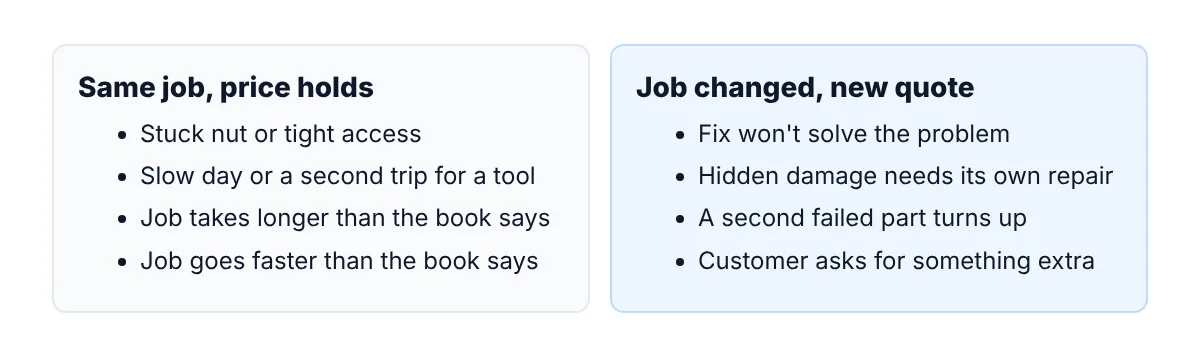
When a job changes after you open it up, stop before the extra work, show the customer, price the new job from the book, and get approval before you go on. The hard part is telling a job that ran long from a job that changed.
A job that ran long is still the same job. The customer approved a fixed price, and you told them it wouldn’t move. A job that changed is different work from what they approved, and they have a right to decide before you do it.
Follow the same order every time:
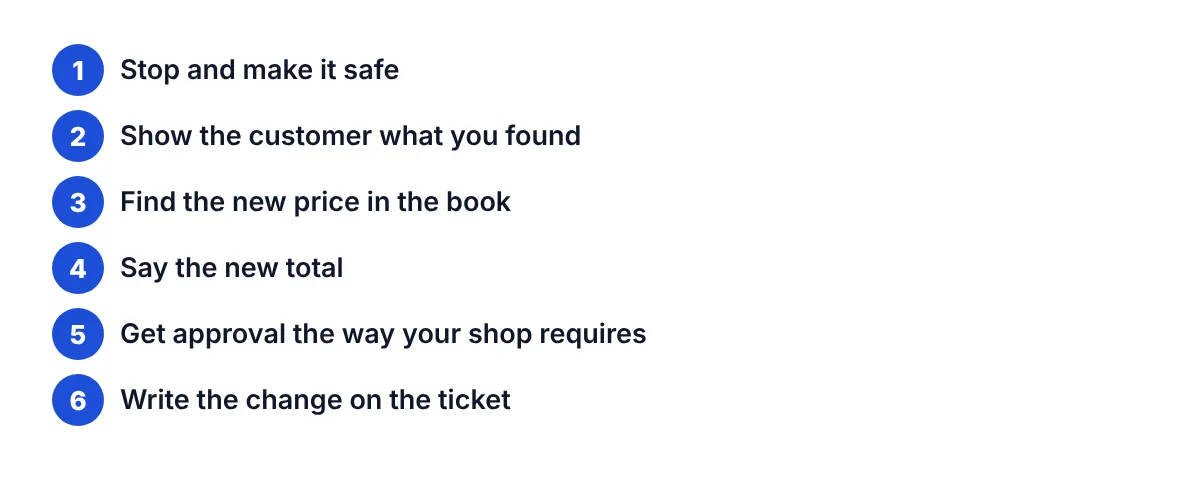
- Stop and make it safe. Don’t leave water running or a fixture half apart while you go talk.
- Show what you found. Bring the customer over, or take a photo.
- Find the new price. Use the book. If the job isn’t there, call the office.
- Say the new total. Give the number they’ll pay for everything, and say what changed.
- Get approval. Whether that has to be in writing depends on your shop and may depend on your state, so follow the office’s rule.
- Write it on the ticket. Note what you found and what the customer said.
You can head off a lot of this before you start. If you can see an old angle stop under the sink, say so with the first price: “If this stop won’t hold when I turn it, that’s a separate item at $X, and I’ll show you first.” Use your book’s number for $X.
Worked example: the $185 fill valve on two bad days
The same $185 job plays out in two ways here, one where the price holds and one where it changes. Our example shop’s numbers are made up, with a $136 billable rate, a $115.82 break-even rate per billable hour and a $45 trip charge inside every price.
Bad day one: the job ran long. The nut is seized and the fill valve takes 1.5 hours when the book allows 0.75.
- Planned direct cost: (0.75 x $115.82) + $18 part = $104.87
- Actual direct cost: (1.5 x $115.82) + $18 part = $191.73
- Price to the customer: still $185
The shop comes up $6.73 short on that ticket ($185 – $191.73), and you still don’t re-quote it. Think about the day the same job takes 20 minutes: the price is $185 then too. Both ends of that deal belong to the shop. If you start seeing a pattern, tell your owner so the book can get fixed.
Bad day two: the job changed. You lift the tank lid before you put the valve in and find a crack weeping at the tank bolts. A fill valve won’t solve that, so the job is now a toilet replacement.
| Line | Amount |
|---|---|
| Approved fill valve price | $185 |
| Book price for toilet replacement | $600 |
| Wrong total if you add both | $785 |
| Right total: the toilet replaces the fill valve job | $600 |
| Change from the approved price | $600 – $185 = $415 |
Both book prices contain the $45 trip charge, and you won’t be doing the fill valve at all. Add them together and you’ve billed the customer for work you didn’t do and a trip you only made once. Show the crack, say “$600 in place of the $185”, and let them decide. If they say no, they still need to hear from you, plainly, that the fill valve won’t stop the leak, and the office should know before you leave.
When to call the office
A plumbing tech should call the office when the answer would change a price rule, the shop’s risk, or what the customer was told on the phone. In a one-truck shop, “the office” may be the owner’s cell. The table below is our suggested list, so ask your owner to mark it up.
| What happened | Why you call | Have ready |
|---|---|---|
| The job isn’t in the book | Someone has to set a price, and it shouldn’t be a guess at the door | What you found, photos, parts, your time estimate |
| The customer heard a different price on the phone | The office knows what was said and what it assumed | The ticket note and the book price |
| The customer asks for a discount | A discount is the owner’s decision | Any lower-cost option that still fixes it |
| The price looks wrong | Fix it in the book, for every customer | The line and the part cost you saw |
| You can’t scope it, such as a leak inside a wall | Your shop may want to use time and materials for this work | Photos and what you’ve ruled out |
| A code or permit question comes up | Rules are local, and the authority having jurisdiction decides | The address and the work involved |
| You damaged something | The shop needs to handle it, and fast | Photos and what happened |
Call early. A two-minute call before you give a number beats a harder call after the customer has heard the wrong one. To see how the phone side works, check quoting prices over the phone.
How to handle a call-back on a flat rate job
A callback on a flat rate job starts with one question: did the same problem come back, or is this a new one? The answer decides who pays, and your shop’s warranty terms decide the rest. Don’t promise a free visit or a new charge until you’ve looked.
- Same part, same fault. Treat it as warranty work if your shop’s terms cover it, and call the office if you can’t tell.
- New problem nearby. Show the difference. A new fill valve doesn’t mean the flapper was covered too. Price the new work from the book, and tell the office.
- You aren’t sure. Call the office before you say who pays.
Write down the cause on every callback. Bad part, install miss, wrong diagnosis or a book line with too few hours all have different fixes. A callback bills nothing and still costs money: in our example shop, one unbilled hour costs $116 at the break-even rate.
Keep the old part if you can, and take a photo. Stay friendly at the door. The customer called because something they paid to fix is acting up, and they’ve got a fair reason to be annoyed.
How to stay a plumber and not a salesman
Staying a plumber under flat rate means your diagnosis starts the price talk and the customer’s decision ends it. Anja Smith wrote in Plumber Magazine in 2018 that keeping plumbers as plumbers was one objection before her shop converted, so you’re in good company if this worries you.
Customers notice too. In an r/askaplumber thread called “How badly was I ripped off”, about nine months old, a poster complained about a flat-rate salesman attitude in the trade. Forum talk, read through a Google snippet on 2 Nov 2026, but a useful warning all the same.
These habits are the ones we’d suggest:
- Recommend only what you’d do at your own house. If you wouldn’t replace it there, don’t suggest it here.
- Say what can wait. “That stop is old, but it’s holding. You can leave it for now.”
- Mention the lowest-cost fix that solves the problem. Every time, even if you’d pick something else.
- Stick to what you can see. Describe the corrosion or the leak. Leave out flood stories you can’t back up.
- Be straight about small jobs. If the fix is two minutes, say so, and explain your shop’s minimum charge before you do it.
- Learn what’s inside a price. The example in how to explain your price shows how a $32 wage becomes a $136 billable rate. Ask your owner to walk you through your own shop’s numbers.
- Tell your owner if a target pushes you to oversell. Pay plans differ from shop to shop, and tech pay under flat rate and hourly lays out how the two compare.
A customer who says no to everything but the repair is still a good call, as long as the repair was done right.
FAQs
Do I have to honor a flat price if the job takes longer than expected?
If the work is the same job the customer approved, yes, unless your shop has a different written rule. You told them the price was fixed, and it holds on slow days just as it does on fast ones. Hidden damage or a different repair is another matter: stop, show the customer and re-quote. Tell the office when one line keeps running long.
What do I say if a customer asks for my hourly rate?
Tell them your shop prices by the job, so they know the total before work starts, then ask the office what your shop’s answer is for anything further. Some shops share a parts and labor split and some don’t. On time and materials work, the customer should hear the rate up front, so check how your shop handles that before you’re asked.
Can a tech change a price in the book at the door?
Only if your owner has given you that authority. A quiet change at the door means the next customer, the other techs and the office all work from different numbers. If a price looks wrong, flag it. Call the office for a one-time decision, and write that decision on the ticket.
What if the customer says no after I’ve opened it up?
Finish the approved work if it can be done properly, and leave everything safe. If the approved job won’t fix the problem, say that plainly and call the office before you leave. Don’t do the extra work anyway, and don’t argue about it. Note what you found and what the customer decided, with photos, in case they call back.
Do I need to memorize the price book?
No. Learn where your everyday jobs are and how the book names them, then look up the rest. Looking up a correct price beats guessing one. Memory goes out of date as soon as parts costs change and your owner reprices, so keep checking even the jobs you know well.
Sources
- Anja Smith, Is flat rate pricing the silver bullet you’re looking for, Plumber Magazine, 15 Jul 2019
- Anja Smith, Confessions of a flat rate pricing convert, Plumber Magazine, 2 Jul 2018
- Aptora, common flat rate pricing mistakes, vendor blog, seen 3 Nov 2026
- r/Plumbing thread “Fellow plumbers” (about 2 months old) and r/askaplumber thread “How badly was I ripped off” (about 9 months old): forum talk read through Google result snippets, 2 Nov 2026, no thread URLs in our notes