
How to give plumbing prices over the phone in 2026: office scripts
To give plumbing prices over the phone, quote the whole price from the book when the job is known, say what it assumes, and price the visit instead when nobody has seen the problem yet. Keep one book for office and techs, so the number on the phone matches the number at the door.
The scripts here are our suggestions, written for this page and not tested with callers. Dollar figures come from our example shop, with made-up numbers, and aren’t market rates. Swap in your own.
What to say when someone asks “how much?”
The best answer to “how much?” is a straight one: give the price if the job is known, and give the next step if it isn’t. You matter here as much as the techs do. In an r/HVAC thread called “Flat Rate vs T&M”, about 11 years old, a poster said the hard part of flat rate was training techs and CSRs. Treat that as forum talk from another trade, read through a Google snippet on 2 Nov 2026.

When the job is known
“Happy to help. Is that just the faucet, or the sink too? And do the shutoffs under the sink work? Great. A standard bathroom faucet replacement with a faucet we supply is $440. That’s the whole price, trip included. If the plumber finds something different when they get there, they’ll show you and give you the price before doing any more. Would morning or afternoon work better for you?”
When nobody can see the problem yet
“I don’t want to guess at that one, because I’d probably get it wrong. What I can tell you is what the visit costs, and that’s [visit price]. The plumber will find the problem and give you a price before any repair starts.”
If your shop credits the visit toward the job, add: “That comes off the price if you go ahead.” Say it only if it’s true on every call.
When the caller wants your hourly rate
“We price by the job, so you’ll know the total before any work starts. For what you’ve described, that’s [book price].”
If the work is time and materials, give the rate straight, along with any minimum.
When it’s after hours
“We can come tonight. The whole price for that tonight is [after-hours price]. The same job during regular hours tomorrow is [book price]. Which works better for you?”
Give both numbers and the caller can decide how urgent the problem really is. How big your premium should be is an owner’s decision, so leave that one to them.
When the caller is calling around
“Sure. For that job, our whole price is [book price], and it includes [parts, labor, trip, haul-away]. If you’re comparing, check that the other quotes cover the same things.”
Then leave it there. Never run down the other shop. If the caller pushes on the number, the plain-word answers in how to explain your price work on the phone too.
What you can and can’t quote by phone
Phone staff can quote jobs with a known scope and a book price, and they should hold back on work nobody has seen. The test we’d use: could a tech walk in and do exactly what you described? If yes, quote it. Where a job falls can vary by shop, so have your owner mark up this table.
| Call | What to give on the phone | What the price assumes |
|---|---|---|
| Toilet replacement | Book price | Standard toilet, working shutoff, sound floor |
| Bathroom faucet replacement | Book price | Working shutoffs, normal access |
| Water heater swap | Book price once size, fuel and location are known | Same type in the same spot, code items checked on site |
| Single fixture drain clog | Book price | One fixture, normal access |
| Second job on the same visit | Tell the caller the tech will price it on site | Your add-on pricing rule |
| Hidden leak or recurring backup | Visit price only | Diagnosis comes first |
| Repipe, slab leak or remodel | Estimate visit | Site visit needed |
We’d keep these off the phone:
- No diagnosis. “That sounds like your flapper” becomes the price in the caller’s head.
- No “starting at” prices. A caller remembers the low number. Give the price and what it assumes.
- No discounts. Those are the owner’s call, so pass them along.
- No code or permit answers. Rules are local, and the authority having jurisdiction decides. The tech or owner can answer.
- No numbers from memory. Read from the book every time, even on the jobs you know cold.
A photo helps a lot here. Ask the caller to text you a picture of the water heater label or the leak. Then a plumber or the owner can say whether a book price fits.
How to state a service fee as part of the whole price
A service fee belongs inside the first number the caller hears, so nobody is doing math on the phone. If your shop builds the trip charge into every flat price, your job is easy: say the total and add “trip included.” In our example shop, $204 labor + $192 parts + $45 trip = $441, rounded to $440.
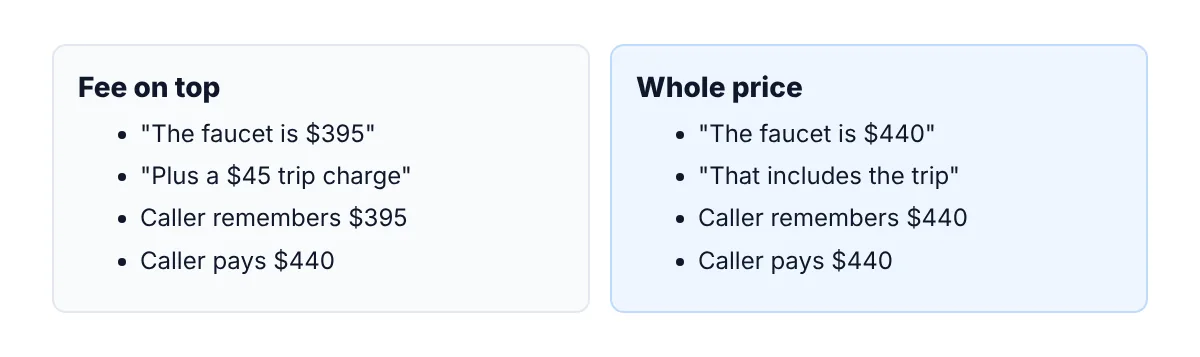
If your shop charges a separate visit fee, say what it is before you book, and say how it fits with the job price:
“The visit is [visit price]. If you go ahead with the repair, the plumber’s price already includes that, so you won’t pay it twice.”
Only say that if it matches your shop’s rule. If a flat price contains the trip charge, the customer pays $440 in total, not $485. We’d suggest ending a quote with “plus sales tax where it applies,” and the owner or accountant can tell you whether it applies to your work.
State rules on mandatory fees differ, and the law is laid out in our guide to all-in pricing and fee laws, which is general information and not legal advice.
Setting the fee is the owner’s job, and the service call fee guide shows the method.
Worked example: when the office sheet and the book drift apart
A price gap between office and tech often starts with one reprice that reached only one of them. Here’s our example shop, made-up numbers. A faucet’s cost rises 10%, the rise itself being a made-up input, and the owner reprices the book. The office is still reading from last month’s printed sheet.
| Line | Old price | New price |
|---|---|---|
| Labor | 1.5 x $136 = $204 | $204 |
| Parts cost | $120 | $120 x 1.10 = $132 |
| Parts at 60% markup | $120 x 1.60 = $192 | $132 x 1.60 = $211.20 |
| Trip charge | $45 | $45 |
| Raw total | $441 | $460.20 |
| Flat price, rounded to $5 | $440 | $460 |
Say you’re the one on the phone, and you tell a caller $440. The tech opens the book at the door and sees $460. Now somebody’s got a $20 problem: the shop gives up $20, or the customer hears a higher number than the one they booked on.
We’d suggest the shop honors the phone price when the job matches what was described, then fixes the sheet that day. Agree on your own rule before it comes up, so the tech isn’t stuck deciding it at the door. Parts changes are handled in how often to update a price book.
How to book the job so the tech hears what the caller heard
A good booking note repeats the price given and everything that price assumed. The tech should be able to read the ticket in the driveway and know what the customer expects.
We’d put these on every ticket:
- Name, job address, best phone number
- The problem in the caller’s words
- Fixture, age and location, if known
- Whether the shutoffs work and whether there’s access
- The price given, or that no price was given
- What the price assumed and any fee mentioned
- Who gave the price, and the date and time
- Photos from the caller
- Whether the person who can approve the work will be home
After the call, send the price by text or email if your shop can. A written line stops the “you told me” talk later, and the customer has a record too. Our estimate template has a valid-until date and a line for what’s included.
How to keep office and tech prices the same
Office and tech prices stay the same when both read from one current book and nobody keeps a private copy. A printed sheet is fine, as long as everyone is holding the same one.
- Use one source. Every price comes from a single book, on paper or on screen.
- Date every printed page. Throw out the old pages when new ones arrive.
- Use the same job names. “Toilet replacement” on the phone should match the line the tech finds.
- Agree on what each price includes. Office and techs should give the same list of what’s covered.
- Send out every change the same day. Tell the office and the techs at once, with the date it takes effect.
- Spot check. Once in a while, pick three jobs and have the office and a tech each read out the price and what it includes. Any difference is a problem worth finding early.
- Listen to each other. Let techs listen in on a few calls, and let office staff ride along or hear how the price gets explained at the door.
Our price book page explains what belongs in a book, if yours is still loose sheets.
Who should own edits to the price book
One named person should own edits to the price book, so every change has a date and a reason. We’d suggest the owner approves any price rule and one person enters the changes. In a one-truck shop those may be the same person, and the change log still earns its keep.
| Who | Does what |
|---|---|
| Owner | Approves the labor rate, markups, fees, discounts and new price rules |
| Office lead or named editor | Enters changes, dates them, sends them out, keeps the change log |
| Techs | Flag missing jobs, wrong hours and wrong parts, with the job they saw it on |
| Everyone else | Reads the book and doesn’t edit it |
The log can be as simple as date, item, old price, new price and why. It answers the question every shop eventually asks: when did that price change? When an edit is a parts cost rise, follow the owner’s repricing method. When it’s a one-time change for one customer, write it on the ticket and leave the book alone.
FlatPriced’s Shop plan is planned to include a tech-only view and repricing history for this kind of setup. The app isn’t live yet, and the founding list is the way to follow it.
If callers keep asking the same prices, post them on your website and let the page answer first.
FAQs
Should a plumbing office give prices over the phone?
For jobs with a known scope, we’d say yes, as long as the price comes from the book and the assumptions are stated. Work nobody has seen is different, so give the visit price and explain what happens next. We found no plumbing data on how phone pricing affects bookings, so treat this as our judgment and test it in your shop.
Can office staff quote a water heater over the phone?
Often, yes, once the caller confirms size, fuel type and location, and ideally sends a photo of the label. State what the price assumes, such as the same type in the same spot. The plumber still has to check the install on site, because local code items can change the work. Say that on the call, and any change gets priced before work starts.
What if the office gave the wrong price?
Decide the rule in advance and follow it every time. We’d suggest honoring the phone price when the job matches what was described, because the mistake was the shop’s. Fix the sheet or book that day. If the job turns out different, the tech shows the customer why and gives a new price before going further.
Is a price given over the phone binding?
We found no source that answers this for plumbers, and it may depend on your state and on how the price was worded. Ask a lawyer in your state if it matters to your shop. As a practice, state what the price assumes, note it on the ticket, and send it in writing, so everyone is working from the same words.
Who should answer price questions in a small shop?
Whoever answers the phone, as long as they have the current book, the scripts and a clear rule for when to hand off. In a one-truck shop that may be the owner, between jobs. A rule like “known job, give the price; unknown job, give the visit price” lets anyone answer the same way.
Sources
- r/HVAC thread “Flat Rate vs T&M” (about 11 years old): forum talk read through a Google result snippet, 2 Nov 2026, no thread URL in our notes